

I'm not posting an update on my Tampa trip (yet), due to some curveballs that got thrown my way these past few weeks and delayed our trip until the beginning of September. Such is life right? So here's all that's gone down in the last month and a half.
Shortly after my last post, Craig and I headed back to AZ Pain Specialists. Our goal in returning to the clinic, where I had seen Dr. McJunkin last year for medial branch nerve blocks at C2-C5 and dorsal root ganglion blocks) was to find out what regenerative treatment options they had in their arsenal. We had initially discussed platelet-rich plasma therapy (PRP) and stem-cell therapy but weren't sure they did that at the C1/C2 level (and it turns out they don't). We discussed a few other potential options to explore like peripheral nerve stimulators, which consists of actually implanting a device under the skin that produces a low voltage current, creating a sensation that blocks the brain's ability to sense the perceived pain. While I'm open to pretty much anything that has a chance at getting rid of my headache, this is one treatment that I just refuse to pursue (for a few reasons). We've discussed the actual research with my neurologist Dr. Dodick and for chronic headaches, the short and long-term outcomes really aren't good. But beyond that, I'm more certain than ever that I have a biomechanical/structural issue at the root of my pain that throwing some electrodes under my skin isn't going to fix. We did leave his office with another round of DRG blocks scheduled for a few weeks out though, as I seemed to have some questionable pain reduction in the following hours after last year's.
By early July, I had finished up my third or fourth prolotherapy session (from C2 and below) without progress. They would have expected at least some reduction in pain by this point, so we decided not to proceed with more sessions.
As I detailed in my last post, Craig and I finalized our trip to Florida for my consultation with neurosurgeon Dr. Franck, but had simultaneously stumbled upon a doctor in Chicago who specializes in regenerative therapies (including those in the upper cervical region). Craig got in contact with Dr. Hauser at Caring Medical , who, after reviewing my case, agreed it was worth flying out to see him. Here's two helpful videos of Dr. Hauser explaining how instability at C1/C2 (which we know I have from my digital motion x-ray) can compress the vertebral artery and cause chronic headaches originating from the suboccipital region. Side note: this is basically the same mechanism of pain that Dr. Franck targets, but obviously with less invasive techniques.
The approach Dr. Hauser uses to heal the ligaments at C1/C2 involves a combination of prolotherapy, stem-cell therapy, and PRP.
Lucky for us, he happens to have two offices - one just outside of Chicago and one in Ft. Meyers, FL, just two hours away from where I'll be seeing Dr. Franck. So we arranged my visits with both doctors during our trip at the end of July, just a few days after returning from our vacation with my family in Massachusetts.
Ahh, yes...about that vacation.
Craig and I flew into Boston on a Friday night. His plan was to be there about a week and I would stay closer to two. Even though I always look forward to annual vacations and holidays, they serve as a harsh reminder of another year passed without relief from my headache. Not to mention that they're supposed to be fun, social, relaxing; an self-inflicted expectation that makes my inevitable need to "leave early" from whenever I am or skip out on plans entirely all because of my intractable headache...that much more difficult to deal with.
I was so frustrated by my pain last summer that I told myself I wouldn't fly home again until my headache was gone. So this past Christmas was the first I ever spent away, but by the time this summer rolled around, I hadn't seen my dad or sister in a year (and only my mom for a few days last fall when she flew out to help take care of me during my ketamine infusion), so how could I keep enforcing a now clearly unsustainable rule? Our vacation was going to be low-key, though, so despite the anxiety I was feeling about my head, Craig and I were both looking forward to some time with my family, a few nights showing him around my college town in upstate NY, a day-trip to the Cape, some time at the beach, and some much-needed R&R.
On our first morning there, Craig, my mom, and I took our dog Zoe out for an easy hike in the woods by my parent's. The plan was to spend the rest of the day at my aunt and uncle's house for a family get-together, so when we got back from our hike mid-morning, I took a shower and got ready to leave. Mid-blow dry, I started feeling a bizarre ache in my left side...at first it felt like mild cramp but worsened by the minute and soon I was curled up on the couch in tears while Craig got directions to the closest hospital. When we arrived 20 minutes later, I was quickly ushered through the ER with apparent text-book symptoms of kidney stones. A CT scan soon confirmed that.
Kidney stones? What the f---?
The doctors gave me some narcotics, which got my flank pain under control and I spent a few hours on IV before being sent home. I was expected to pass the stones in a few days and prescribed more pain meds to stay comfortable until then. Craig and I ended up back in the ER in the middle of the night though, as the pain had gotten out of control again. This time, I was given a narcotic called Dilaudid, which helped my kidney stone pain but little did I know, would become my worst enemy over the next week.
We finally got back home early Sunday morning and tried to catch up on sleep. I was still feeling pretty shitty so spent most of the day in bed or on the couch. By Sunday night, things started to get really ugly for me as my headache started to climb beyond its normal baseline. The feeling of a drill going through my temples kept me up all Sunday night and by Monday morning it had reached an unbearable level. I couldn't eat or drink without throwing up, I couldn't sleep and I could barely talk because of the pain. Between my kidney stone discomfort, which wasn't exactly manageable at this point either, and the terrifying headache spike, we were back in the car to the hospital. This time we knew we needed to go straight to Mass General in Boston.
After a long few hours waiting in ER, I was given more pain meds and and later admitted overnight for observation. We had figured out at this point that I was having a rebound headache (layered on top of my normal headache) from the Dilaudid I had been given over the weekend. As uncomfortable as the whole kidney stone ordeal was at the point, I knew it was temporary...the pain I was feeling had an expiration date. My head, on the other hand, was a different story. I knew the increase in pain from the narcotic couldn't last forever, but I was also fully aware that I was in the best hospital in the country with a headache like I had never felt in my life and that I would be leaving the hospital in how ever many days with my headache. It made the whole situation feel more overwhelming than I can explain. Each time a doctor or nurse would ask, "what normally helps your headache at home?", I felt so helpless having to answer, "nothing, nothing helps it". By that point, Craig had been in communication with my Mayo neurologist, Dr. Dodick, who was then able to speak to the doctors at MGH and make some recommendations for my head. Finally, an IV drug called dihydroergotamine mesylate (DHE) seemed to get things under control. Speaking of Craig, if I had any ounce of doubt before this trip that he wasn't the best, most caring, loving, resilient human on the planet (which, for the record, I didn't), it's gone.
By Tuesday, I hadn't eaten and barely been able to drink since Saturday and that was definitely catching up with me too. I was on so many meds at that point that I'm not even sure what was making me sick but any sip of water that went in came straight back up along with plenty of dry heaving. Nice, huh? At some point on Tuesday morning, I woke up with a 103 fever, which was an obvious red flag for a blood infection. Apparently kidney stones can disrupt the whole filtration system enough that bacterial infections can occur. Later that afternoon, off I went to the OR to have a ureteral stent put in (which goes from kidney to bladder). This would stay in for a few weeks until I was finished my antibiotics and then I'd get both the stent and the stones taken out back home in AZ at Mayo Clinic.
I spent a few more rough nights in the hospital and finally got home Thursday night. I spent the next few days in recovery mode - slowly getting my appetite and energy back. My neck and upper back were in rough shape from from being in a hospital bed all week so I had a few massages scheduled, but my head took another turn for the worst on Monday after my first massage. We think I maybe still had some Dilaudid in my system or something. I realized when I arrived back in Phoenix on Tuesday that I had lost at least 10 lbs in 6 or 7 days, which had me feeling really drained.
In the whirlwind of the previous week and half, we hadn't really had time to deal with the obvious question of why the hell I had gotten kidney stones. They don't run in my family, I hydrate like a f-ing champ, I don't drink soda, I don't consume a ton of animal protein, I eat a completely unprocessed diet. The only thing that seems like a potential risk factor is that I consume a fair amount of high-oxalate foods like beets, spinach, and nuts, but could that really be the cause? I still don't know for sure what the reason is but during my consultation with the Mayo urologist the day after I got home, I found out that an anti-seizure medication I was on last summer for my headache, Topomax, is known to cause kidney stones. And even though this was a year ago, apparently the stones can take that long to develop. Awesome.
As I sat in the urologist's office that day, frustration with my headache was boiling over in the same way it had back in Boston when the doctors calmly asked what I take at home for pain relief. My eyes welled up with tears as the doctor walked me through the details of the incredibly routine procedure he'd be performing the following week...but not because I was afraid of getting a kidney stent taken out...What was really making me upset was how f-ing straightforward the whole thing was. I got kidney stones...they hurt, it sucked, I went to the hospital, I had a procedure, I took medicine, and in a few weeks it would all be behind me. That's how these things are supposed to work. So why, three and half years and over a hundred doctors later, do I still have a headache? No temporary pain, however bad it is, compares to the inescapable agony of chronic pain.
On Tuesday (two days ago), I went back to Mayo to get both the stones and the stent removed. Before surgery, they said there was a high probability that my ureter would be inflamed from the stones and another temporary stent would have to be implanted to keep it from closing up, but fortunately, when I woke up, I found out I was in the clear. In fact, the stones didn't seem to be there anymore (maybe broken down on their own) but whatever material they did recover will be tested to know for sure if the Topomax played a role.
Long story short, all of this nonsense is the reason the Tampa trip is pushed to next month (and also the reason I postponed the DRG blocks to a later date). I wanted to have a few weeks for my body to get back on track - to eat well, work out as much as I can tolerate - before beginning the regenerative therapy treatments. I'll be going into a neck brace for the 12 weeks of those treatments so mentally as much as physically, I needed a few weeks to decompress and get my shit together. And before FL, we also have a quick trip back to Austin for a follow up with dentist Dr. Ueckert and upper cervical PT Mark Strickland. I've been wearing my dental splint since we initially saw them back in January and need to figure out the next steps with that.
So...come on September, I'm ready for ya.
Thursday, August 6, 2015

Thursday, June 25, 2015
Prolotherapy and Tampa-bound
It's been a rough month or so for me on the headache front. It started with some weather changes that I mentioned in my last post. Those abnormally stormy/humid conditions lasted a few weeks, and reaffirmed the connection between lower barometric pressure and significant spikes in my pain. We're not totally sure the reason for that, but speculate it has something to do with my cerebral spinal fluid flow or inflammation in my cervicogenic region. The weather cleared up and has returned to the glorious dry triple digits that is summer in Arizona, but I haven't seemed to be able to catch a break, headache-wise.
I've been able to continue pushing myself in the gym and getting on my mountain bike when the weather allows for it. Starting my day with a lift feels really good. I know I'm getting stronger with each workout, but most importantly, I feel the stress of my headache melt away. It makes me more mentally resilient...better equipped to handle the next 24 hours of my headache without completely losing it. I wouldn't wish that form of motivation on anyone, but I can tell you that it's pretty f-ing effective.
Needless to say, it's been refreshing to channel my blogging energy elsewhere (Hah! I guess you know a headache is bad when afternoons spent researching the ingredients in laundry detergent and sunscreen are a welcomed distraction...am I right?)
So I had mentioned in my last post that I was beginning a series of acupuncture treatments with Dr. Jing Liu. As hopeful as I was, this round was a bust like all the rest. I knew that if I was going to go down the Chinese Medicine route again, It was going to require some time and patience, so I committed to at least a few weeks of treatment regardless of whether I felt any changes. I completed 10 sessions over the last month(along with drinking my twice daily dry-heave-inducing herbs) but decided to call it quits after Tuesday's session. The whole blood stagnation thing in my c-spine and scalp makes a lot of sense to me, but ultimately, my frustration boils down to feeling like there's still a biomechanical or structural dysfunction in my c-spine. And if something in my neck isn't in the right place, whether it's a result of ligament damage or something else, how can more acupuncture correct it? I'm glad I gave it another shot, for sure, but another series of failed attempts takes a toll on my optimism. Clearly, in need of some new direction.
And...cue the serendipitous turn of events.
The fellow-headache-sufferer from Canada that I mentioned before, who stumbled upon my blog and went to see the atlas-orthogonal chiropractor in New York I had written about, happened to email me a few weeks ago with a link to a video he had found and thought I may be interested in.
The video, which I've posted below, shows neurosurgeon Joel Franck, MD, speaking at the FONAR's Cranio-Cervical Syndrome Symposium in 2013. His presentation is titled, "When the Atlas Shrugs: Post-traumatic Migraine Headaches and Lateral C1-C2 Instability - a New Syndrome; Dynamic Motion x-ray (DMX), pMRI Diagnosis, and Treatment with C1-C2 Transarticular Fusion Utilizing Stealth Image Guidance and O-am Intra-operative Virtual CT Scanning. Yikes, that was a mouthful.
In patients with chronic, post-whiplash migraines/headaches, Dr. Franck is using both digital motion video fluoroscopy and upright MRI and finding in most patients, clear abnormality of the alar or transverse ligaments. The ligament damage is what accounts for lateral slippage of C1 on C2.
Here's a clear explanation of what happens (excerpts taken from Dr. Franck's website):
"...in a whiplash injury, these ligaments may get damaged – sometimes severely so. This is particularly true as regards the Alar ligaments and Transverse ligaments, connecting C2 (the axis), C1 (the Atlas), and the Occiput (Bottom of the skull). As explained before, the Cervical DMX and the Upright MRI demonstrate that in whiplash damage to these ligaments causes abnormal lateral, side to side, sliding of C1 on C2.
This lateral sliding causes abnormal tension on the vertebral arteries. We have demonstrated this in the operating room by directly observing that vertebral artery flow is disrupted by the laxity and abnormal loose movements of C2 and C1.
Abnormal tension on the vertebral arteries causes a wave of spreading contraction in these vessels and this may be the origin of the severe intractable headaches. These post-whiplash disabling headaches are most often described as pounding and throbbing, characterizing them as “common migraine” headaches. This subjective feeling reflects the vascular nature of the headache – waves of vascular contraction and dilatation.
...There is more: Recall that many whiplash patients who sustain Alar and Transverse ligament damage develop inflammation at C1-C2 in the spinal canal. A mass develops in that area which we describe as C1 Capsulosynovitis. Further, many of these patients also develop a sinking of the posterior part of the brain, including the cerebellum, into the opening of the skull base – the foramen magnum, which is called Cerebellar Tonsillar Ectopia.
Together, these two phenomenon cause severe crowding and pressure on the brainstem and vertebral arteries...
...Cerebrospinal fluid (CSF) is produced in the center of the brain in a space called the ventricles. CSF is an “ultra-filtrate” of blood, and is essentially similar to ocean salt water. It also contains immune related proteins and other factors. The CSF circulates around the brain and spinal cord after leaving the ventricles and then is reabsorbed on the top of the brain.
After a whiplash injury that abnormally affects the upper cervical spine, as mentioned, the opening of the base of the skull, the foramen magnum gets compressed or crowded. This can be demonstrated to adversely affect the flow of CSF around the brainstem and spinal cord. This may play a role in the development of the Cranial Cervical Syndrome."
Dr. Franck is treating this condition with a minimally invasive cervical fusion of C1 and C2. Basically he makes an incision at the top of the cervical spine, below the skull, and two small insertion points at the base of the cervical spine. Then, using the STEALTH radar system, he carefully guides two 4 mm diameter titanium small screws from the insertion points, by a minimally invasive technique to connect C1 and C2. Then he applies bone fusion material directly on C1 and C2 and finishes by removing two square centimeters of bone from the occipital skull base at the top of the spine, in order to remove the pressure on the base of the brainstem shown on the upright MRI.
You can see where the screws are positioned here:

Craig and I watched the video with wide eyes and when it finished, kind of looked at each other like, holy shit, this is me. Imaging from the case study he walks through in the presentation mirrors mine to a T - including the C1/C2 "rocking" from my digital motion x-ray and the spinal cord "kink" that shows up in my MRI...sort of resembling a basilar invagination/Chiari malformation but not enough to qualify as remarkable to most doctors who have seen it.
We immediately got in touch with Dr. Franck, who's based in Tampa. After reviewing my motion x-ray and MRI, we got an email from his office "this is a GREAT case - call them and please get her down here ASAP - I can change this gal’s Life." He told us that he's performed the operation for "precisely the indications Katie presents with on over 85 patients worldwide, with remarkable and positive results. While all surgery has risks, statistically, this operation is extremely safe and has a terrific track record of minimizing post-whiplash intractable migraine headaches."
When I saw the email, my eyes immediately welled up with tears, for 2 very different reasons:
1. Indescribable hope and happiness at the prospect of a solution existing that could actually correct the root cause of my headache and mean I wouldn't be in pain the rest of my life
2. Overwhelming fear and anxiety at the prospect of having a cervical fusion - not around the operation itself but all of the questions I already had about long-term outcomes. Would the pain relief last? What if it came back? Would I be able to have an active lifestyle? Could I ever mountain bike again? (The mind moves fast, you guys know)
But like always, Craig talked some sense into me and reminded me that we'd just have to take it one step at a time, starting with a consultation with Dr. Franck. He ordered an upright MRI (which I had done yesterday), and we're scheduled to fly to Tampa in just a few short weeks for the visit.
At some point while all of this was going on, Craig and I decided now was a good time to explore some regenerative therapy. If the ligament instability is truly the culprit, we figured it's worth trying some less-invasive ways of correcting it. So last week, I saw Dr. Cronin at Naturopathic Physician's Group for my first prolotherapy treatment. I know I've talked about prolo before but here's the gist:
Prolotherapy (aka Regenerative Ligament Therapy) is a series of injections used to treat pain from ligament damage. You've probably heard before (or maybe know because of your own injury) that ligaments, joint capsules, and cartilage aren't the best at healing. That's because they have a very slow metabolism and are made of dense, white collagen with a poor supply of fresh blood and nutrients (not to mention the constant structural stress they're under). So prolotherapy works by feeding the ligaments to make them stronger. The nutrient solution that's injected is a combination of glucose and procaine. The ligaments become strengthened as a result of the injections by rebuilding of collagen.
I had my first prolo session last week, my second one this morning, and will plan to go back in two weeks for number three. Dr. Cronin is injecting a few spots from C2 down. He can't hit C1 because that requires ultrasound guidance (prime real estate) and only a few people in the country do that. We figure we'll start with C2/C3 and if we need to travel somewhere to have C1 done under guidance, we'll cross that bridge if and/or when we get to it. So far, I'm not feeling anything positive from the injections (just an increase in pain in the few days after) but that's not abnormal. We're going to give it at least 5 sessions regardless.
In the meantime, I've been adding this collagen supplement to my morning smoothie to help the healing process along. Stay tuned to ALO's blog for an upcoming homemade (delicious) chocolate hemp milk recipe using the same joint-healthy collagen.
I'll plan to post again after my next few Prolotherapy treatments, and definitely after our trip to Tampa. Crazy that in a few short weeks, it'll be the four year mark since my bike accident. Hoping this summer is a game-changer.
Thursday, May 28, 2015
brain integration and new acupuncture
I've written and deleted at least 10 opening sentences to this post...and have decided there's no better way to say, "headache unchanged". I hate writing that for a lot of reasons, but there it is.
On a positive note, the progress I've made in physical therapy over the last few months has finally allowed me to get back into a normal workout schedule again without feeling like I'm just plowing through biomechanical dysfunction. Getting out on my bike and back in the weight room after months of trying out all kinds of modification strategies feels pretty f-ing great. I've said this a million times before but worth repeating: pushing myself physically doesn't change my headache, but it changes my ability to mentally deal with it in a way that I can't fully articulate. Anyone who works out can tell you that exercise makes you feel good, but when your baseline is chronic pain, "feeling good" takes on an entirely new meaning. It makes every extra effort - every pull up, every sprint, every climb, worth it. And reaching physical milestones as a result of that effort gives me sustained hope that in time, everything I do for my headache will pay off.
On the treatment front, the last few weeks have been busy with a new therapy called Brain Integration.
Brain Integration Therapy (BIT) is a non-invasive approach to permanently correcting the neuro-pathway blockages in the brain that can be the root cause of a variety of neurological problems - including ADD/ADHD, dyslexia, emotional control issues, PTSD, and the debilitating after-effects of certain head injuries, especially post concussive syndrome. BIT identifies and corrects the areas of the brain that are not working properly by using muscle monitoring, acupressure, left/right brain integration, and emotional memory stress release.
Although the bulk of BIT seems to be focused more on behavioral/cognitive issues than chronic pain, we decided, based on what we know about neuroplasticity, that we couldn't afford not to give it a go. So I've been working with a local practitioner a few times a week. Tomorrow will be my last session, which will bring me to a grand total of about 16 hours of treatment.
The sessions themselves are pretty passive on my part, with the exception of some muscle energy testing and basic balance exercises. The only treatment that was uncomfortable was this past Tuesday's, which consisted of a lot of eye movement exercises. After a few months of chiropractic neurology earlier this spring, it didn't surprise me to experience a massive pain spike afterwards.
So far though, I haven't felt any positive changes. I'd be lying if I didn't say I was disappointed or discouraged, but I'm really making a conscious effort not to get bogged down by that. I think theoretically it could take some time too.
We also decided to seek out a new acupuncturist who had some specialization in scalp acupuncture. This morning I had my first visit with Dr. Jing Liu at Eastern Medicine Center. Craig and I were both super encouraged by this morning's session. It's always interesting to tell the same story to different practitioners and understand all of the different lenses through which they see it. Not that one is right or wrong, just different.


Dr. Liu seems confident that soft-tissue "tightness" is impairing my circulation and lack of circulation is causing dehydration of my brain. She pointed out (which you can see in the photo below) the red area around the base of my skull and under my hair as an indication of the poor circulation. I have to say, just based on the congestion and tenderness and even nature of pain I feel, it does makes sense to me.

After my first treatment today, Dr. Liu sent me home with a regimen of Chinese herbs that I'll be taking twice a day to facilitate the healing process. Next week, I'll go back for three more treatments, and that will likely continue for the next few weeks. I'll plan to post an update in the next few weeks (hopefully with encouraging news!)
Ok, one last thing. As shitty as my headache is, I can't deny that positive has come from it. It's been such a part of my life for the last 3.5 years...how could there not be bright spots? When I started this blog in 2013, I had no idea how fulfilling it would be to publicly tell my story. At the time, my number one motivator was really just to organize my treatment history so my head didn't feel like it was going to explode every time I walked into a new doctors office and was asked, "so what brings you in today?"...that, and to keep my close friends and family updated on my treatments.
Through the process, though, I've realized how much I love writing (even if the subject matter could use an upgrade). Recently, I connected with a reader of my blog from Niagara Falls, who had stumbled upon it during his own quest to overcome a chronic headache. He ended up going to see a doctor in New York - who uses upright MRI to study impaired cerebral spinal fluid flow at the cranio-cervical junction caused by misalignment of the upper cervical vertebra - after reading about him in one of my previous posts.
Knowing that a stranger in Canada had been offered a glimmer of hope, a nudge in the right direction as he searched desperately for answers just like I was...made a year and a half of writing this blog worth it. And it's the reason why I'll keep writing it until my headache is gone, despite how painfully (pun intended) lame and redundant I sometimes feel my posts have become.
And that leads me to my sort-of-unrelated but also totally-related-at-the-same-time project I'm excited to share with anyone who actually reads all the way to the bottom. A few weeks ago, I launched a new blog and website dedicated to environmental health. ALO is an educational platform committed to arming you with compelling, scientifically-driven information about the toxins in your everyday environment and empowering you to eliminate or reduce your exposure with practical, accessible solutions. I'm only a few blog entries deep, but am working hard to build content that will resonate with people looking to make positive changes in their health and lives. If there's one thing this damn headache has taught me, it's that there's no impact too small. Please check it out and feel free to share with anyone you think might be interested. Feedback is welcome and appreciated!
www.alo.solutions
Tuesday, April 14, 2015
functional neurology and PT update
It's been about a month since my last post, but don't take my radio silence as not too much goings-on. There's actually been quite a bit happening on the treatment front, I've had a hard time getting myself into any kind of blogging mood. I think I've started about 15 times, got 3 sentences in before having a "holy shit I'm so over this" moment. Over having a headache, over thinking about my headache, over talking about my headache, and yes...over writing about my headache.
And I try my best to really understand what treatments or therapies I'm actively pusuing, how they work, exactly how they can help me, etc. But over the last month, I've struggled to conceptually grasp (at least enough to confidently articulate, that is) how some of what I'm doing is moving me closer to a headache-free tomorrow.
Ironically, though, writing it down is usually the best way for me to make sense of it all, which ultimately gives me belief in the process. And belief in the process gives me hope for the outcome.
So, bear with me.
Since my last post, I did go back to try my second ozone therapy. Luckily this time I didn't have another bizarre dizziness/vomiting reaction that night like I did the first time...but unfortunately didn't feel any improvement in my headache either.
A few weeks ago, I started seeing a chiropractic neurologist here in town, Dr. Russell Teames at Arizona Chiropractic Neurology. Chiropractic neurology, by definition, is a sub-speciality of chiropractic that focuses on optimizing the function of the nervous system using conservative, non-pharmacaeutical based methods. I'll try to simplify this explanation as best as possible. Honestly though, I don't fully understand a lot of it, but hopefully this explanation will help...
The nervous system has supreme control over the musculoskeletal system as well as the organ systems in a precise manner. Specific parts of the brain are responsible for the well being of certain regions of the body. Dysfunction in a particular brain region will then manifest itself in symptoms in the associated body areas. For example, an under-functioning cerebellum region of the brain may produce signs and symptoms related to neck pain due to the intimate control of tiny postural muscles in the neck. With brain-based rehabilitation the chiropractic neurologist will not only manually treat the area in question itself with physical medicine but will also “exercise” the deficient region of the brain to normalize function. Since the brain is plastic, with appropriate treatment it can attain optimum wellness. Treatments may entail specific types of eye movement exercises (known as “oculomotor rehabilitation”), balancing activities, oxygen supplementation, rotary activation (chair spins), eccentric fast stretching, cross cord mechanisms, therapeutic use of light, therapeutic use of sound, therapeutic use of smell, and physical activities using one side of the body.
Dr. Teames has been using videonystagmography (VNG) as a diagnostic tool. Basically I put on these crazy video goggles with infrared camera inside and go through a series of tests that require me to follow a moving dot in various directions and speeds. The VNG system uses the video imaging technology to record, analyze, and report my involuntary eye movements (which are called "nystagmus"). Based on my performance on those tests, I'm given exercises to retrain my ocular system and bring balance back to my nervous system, which could theoretically impact my postural and musculoskeletal systems. For example, let's say I'm not moving my eyes perfectly to the left...I may compensate by holding my head in slight left rotation.
The best way to think about this so your head doesn't explode (at least for me) is that just like your body can change and we use physical therapy to change it, your brain and nervous system can change (neuroplasticity) and chiropractic neurology is can be used to change it. We're hoping that as I get better input, that will bring proprioceptive, vestibular, and ocular input into better alignment, causing less "noise" in the brain, and hopefully...less pain!
I've been going a few times per week for the last 3 weeks and have made a little bit of progress with my eye movements, but not as much as he would like to see and an improvement is obviously not reflected in my pain levels, which kind of blows. I'm certainly glad we're giving it a shot because that sure beats not trying something but I'm not really sure how much longer I'll continue if I don't start making more tangible progress. I'm forcing myself to stay optimistic, but it's really challenging to maintain the mental energy and focus required to commit to any treatment path when I don't feel like I'm really moving forward.
Switching gears now...
Over the past few weeks, I've also continued my physical therapy with Jeff Beran. As I detailed in last month's post, we've been been working on getting my serratus to activate properly so that my upper trap and levator scap can...well, basically calm the fuck down. After the initial sense of "relief" I felt through my upper back and neck (which is where I left off in my last post), I seemed to settle back in to my default pattern of pain and tightness. In this time, I've had a few days here and there of reduced pain, and then what seems to be an equal number of days where my my headache is flared up up above and beyond normal.
Despite the stubbornness of my headaache, though, I have made huge improvements in my serratus activation. The greatest challenge for me has been linking that with proper torso stabilization.
So right now, the focus is on integrating those. My go-to stabilization strategy has always been more rectus-abdominus dominant (think "6 pack" muscle). When that happens, my ribs flare up and then to compensate, I end up shifting my head forward just to maintain a neutral position. This then creates a significant folcrum that my neck has to stabilize against. It should also be noted that any lack of stability in my trunk is just going to place demand elsewhere to provide that stability (i.e. higher up the chain in my upper back and neck).
So we've been working on changing my stabilization strategy to that of more global recruitment. I recently shared this timely article, How are we still getting it all wrong: abdominal hollowing vs. bracing on my Facebook page, which does a great job of explaining how the abs-pulled in (i.e. "hollowing") strategy is all wrong. It activates a single muscle in isolation, rather than as a team, which is of course how they work in real life. So every time I think I'm "activating" my core, I'm essentially turning single muscles on at the expense of turning others off. The end result is far from stability.
It's taken some time for my body to figure out this "bracing" thing, but with some practice, I do feel like I finally got it. Here's an excerpt from the article above...
Think about what you would do if you were to prepare yourself for someone to punch you in the gut. You would immediately tense and stiffen you core to brace for the impact. This is exactly what abdominal bracing is, a term first coined by Dr. Stuart McGill of Canada, a leading expert in spine mechanics.
In abdominal bracing, you are simultaneously co-activating all layers of core muscles (remember the anatomy lesson?), in addition to activating your lats, quadratus lumborum, and back extensors. This means the entire abdominal wall is activated from all angles, sides, and directions, causing the three layers of the muscles to actually physically bind together.
This binding enhances the stiffness and stability of the core to a much greater degree than what would otherwise be produced by the sum of each individual part. This is what McGill refers to as superstiffness. It is this stiffness that provides us with 360 degrees of spinal stability, making us injury resilient and helping us achieve optimal performance.
You see, stiffness is actually key for spinal stability and spine health. Having a stiff core eliminates micro-movements in the joints that lead to spine and tissue degeneration. Without stiffness, these micro-movements would gradually gnaw away on our nerves, eventually causing pain and even disability. Stiffness braces these micro-movements and takes away the pain, essentially building a spinal armor.
Now, I can actually work on integrating my serratus activation with my improved torso stabilization.
If your brain works in any way like mine, you may be wondering how the hell this all ties into my headache. What it comes down to is the reality that the body is a working system, not a bunch of isolated parts and sometimes to get individual parts working optimally and feeling better, the system as a whole must become the focus. The logical part of me knows this, and appreciates this holistic view beyond belief. After all, I've had so many needles stuck in my cervical spine to target one nerve, popped so many pills to try knocking out my pain, seen so many doctors who specialize in the "neck up". If those things had worked, I probably wouldn't be complaining...but they didn't, so here I am. I can't afford to not step back and say, "ok, we know it's all connected so let's fix all of this dysfunction, improve my total-body mechanics and have faith that my headache will resolve". I have days where this approach feels more overwhelming than I can even explain. It's hard to measure progress, after all, by anything other than my headache improving. But I know it's the path I need to pursue, so I just push through the moments and hours and days that feel overwhelming and give myself credit for the biomechanical progress that I am making (I love you, Craig).
Speaking of that progress, yesterday's PT was a definite feel-good visit. All of the time I'm spent at home practicing has clearly been paying off, as evidenced by the improvements in both my torso stabilization and shoulder mechanics. We decided today that it was even time to start challenging my body a little more (cue the celebratory music).
Over the past few months, I've progressively scaled back my activity level. First I stopped lifting, then mountain biking, and now even the most basic Pilates exercises have been modified to avoid creating excess tension that could be feeding the pain loop. I was even advised to stop my sprints on the versaclimber and Keiser bike. Mentally, exercise has has been the strongest, most effective medicine for me through it all. In the same way that a solid night of shut-eye (compared to pulling an all-nighter) enables you to handle the stressors of a busy day ahead, exercise arms me with the resilience to mentally "deal with" the reality of a 24/7 headache.
But even though restrictions on my activity level have taken a toll on me, I'd willingly hop into a full body cast if it meant getting rid of my pain. The problem is, even with all of these modifications, I haven't felt an ounce of improvement. And this isn't an isolated experience - last winter I spent 9 weeks in a cervical collar to restrict movement and the same held true.
So even though I'm not ready to jump on my mountain bike quite yet, Jeff is totally aligned to my thought process and now that we have improved some of my foundational stability, he's helping me to start re-introducing some exercises back into my rehab to progressively challenge my system. This morning I started some overhead pushing, and last night Craig and I went over a few strength exercises for me to start at EXOS, most of which will use compressed air resistance to help minimize stress on certain parts of my body. It takes a little more creativity for metabolic workouts, but between sled pushing (which is actually great for helping to keep my serratus activated, the Woodway Force, and a few other power exercises using some of the Keiser equipment, I've got plenty of tools in the toolbox. And having to figure that out is pretty much the best problem I could have right now :)
Thursday, March 12, 2015
holy serratus
It's only been a week since my last post, and although I seem to have slipped back into my "normal" headache since the few days of sustained reduction a week ago, I do have some interesting rehab progress to report.
First though, a quick update to the ozone IV therapy from last Wednesday. I hadn't felt anything unusual except for maybe a little fatigue when I posted my most recent blog entry on Wednesday evening. But by about 9 pm that night, while lying on the couch (getting our nightly fix of House of Cards, obviously), I started feeling really dizzy. Dizziness and nausea are typically NOT symptoms I experience with my headache so I knew it was likely a reaction to the ozone treatment. The dizziness progressed pretty quickly over the next few minutes until I was throwing up an equally impressive and disgusting amount. There's nothing quite like a night with your head in a bucket to make you and love and appreciate the guy holding your hair back. Am I right?
So it really took me a few days to recover from that little episode...aside from feeling generally lousy, my headache had spiked back up to a high-normal range...where it's stayed for the past week-ish.
I had decided to stop seeing Dan Daliman for PT. Recognizing that I had made some significant progress with him over the last 6 weeks in strengthening my deep flexors while maintaining my c-spine alignment, I felt that we had hit a bit of a plateau and it was time to figure out the next step.
"Figuring out the next step" isn't a straightforward process, but the longer I've been in pain and seeking treatment, the better I've become at trusting my own intuition. When dealing with a chronic health condition of any kind, the ability to confidently weigh in your "gut feeling" with the advice and expertise of those around you isn't always easy, but so important. After all, there is not a single person in the world who knows and feels your body the way you do.
With that said, I've been growing increasingly frustrated by our inability to connect the dots between my headache and the chronic tension in my upper left back. As I've explained before, the "tightness" has felt so deep and SO connected to my pain above, yet has been completely unresponsive to all tried modalities by the best practitioners in their fields over the last several years...massage, dry needling, cold laser, ultrasound, acupuncture, cupping, various injections...the list goes on and on.
Of course, we don't for sure if this "tension" is manifesting as a response to my pain rather than the other way around, which is one reason that chronic pain is so tricky. I've talked about the pain-spasm-pain cycle before and the complexities of centralized pain but as a refresh, the longer you're in pain, the easier the brain's ability to properly process pain perception can change, becoming hypersensitized to pain input. It's a self-feeding mechanism...and a really shitty one at that. We're still trying to figure out the best way to tackle this possibility. So far, I have tried quite a few things that can be effective in treating more centrally-driven pain, from various medications (including the ketamine infusion) to other less invasive treatments like brainwave optimization, transcranial magnetic stimulation, eye Movement desensitization and reprocessing, etc.
But because I just refuse to give up chasing down this left upper back connection, we've decided to try a few new things. Earlier this week, I met with Tony, one of the PT's at EXOS who I've seen in the past. He pointed out how much less thoracic rotation I have on my left side and so decided I'd spend a few sessions trying to tackle that.
Yesterday, I also saw Jeff Beran, PT who I started back in the fall of 2013 (yikes!). After Craig and I caught him up to speed with findings from the past year since we last saw each other and he evaluated me, it become clear to him that my scapular mechanics are disrupting my cervical spine mechanics. This disruption was further evidenced by a few observations: my left shoulder is lifted about 1 inch higher than my right when lying supine, and my left pec minor is significantly tighter than my right.
Jeff hypothesized that the specific spot I feel on the left side is likely referred pain from the C5/C6 level, which is being affected by the scapular dysfunction.
It all makes a lot of sense to me, based not only on my understanding of the anatomy (see below how the levator scapulae connects the c-spine to the scapulae) but really more so what I FEEL is going on in my body.

It's turns out that I haven't been activating my serratus muscle (see below). Like is so often the case, it's not a matter of strengthening a muscle but actually re-learning how to fire it correctly. Proper activation of the serratus (see below in red) keeps the scapulae in better contact with the rib cage.

You can physically see my serratus "turning on" in this video.
And then, when we try to progress to lifting one arm (which we soon found out I wasn't ready for), you can then physically see my levator/traps taking over. I KNOW that the "tension" of those muscles is part of my headache and really feel like this discovery is an important breakthrough in cracking the code.
So the plan now is to do these serratus-activating exercises until they're boringly easy and then I'll go back to see Dr. Beran to keep progressing them. I've been activating my serratus all day long like a f-ing champ and the exciting news is that even in this short time I can already feel a significant difference in the tension through my upper back and into my neck. The hope now as I continue is that pain reduction will follow!
I'm also still on a once-weekly acupuncture schedule. In today's session, Sara tried a bit of new approach based on everything that's happened with my PT visits this week. Team effort at its finest.
Wednesday, March 4, 2015
March update!
I'm happy to finally be reporting some encouraging updates today! Oh how I've dreamed about these blog posts. I still have a ways to go with my headache, but it seems like progress is finally being made.
Over the last few weeks, I've stayed pretty busy with my rehab, continuing my weekly physical therapy visits with Dan to strengthen my deep neck flexors while maintaining my new alignment. We've incorporated some other things into my treatment, including exercises to strengthen my external shoulder rotators. We've figured out that the soft-tissue dysfunction and chronic tightness on the left side of my upper back (which goes all the way back to my original bike accident, and therefore has always felt - at least to me - connected to my headache) is coming from my 5th rib. At this point, it's so hard to know what's driving a problem and what's a symptom, but the current approach is simply to attack it all and trust that pain reduction will follow.
Along with my PT, I've had a few more sessions with Anna at Movement Rev as well as acupuncture treatments with Sara Asadoorian-Vagianos at Advantage Sports Acupuncture. My visits with Anna have been focused on opening up my lateral line and superficial front line to aid in my thoracic spine mobility and improved diaphragm function, and improved deep frontal line function. The goal of this is improve the mobility of my spine and hopefully take some of the pressure off my neck.
Even though I've had a lot of dry needling in recent months, it had been a while (i.e. pre- corrected C1/C2 alignment) since I'd had traditional Chinese medicine acupuncture. These treatments with Sara have focused on releasing heat and stagnation in my body, and to restore energy flow, blood circulation, and function along the Urinary Bladder meridian (which runs from the corner of your eye, up and around your head, down along the paraspinals, down the sacrum & hamstrings, and ends at the corner of your pinky toe). Sara told me that releasing any blockages or adhesions along the UB meridian will open up the spine on both the functional and energetic level.
Up until about a week ago, I wasn't feeling any changes but then something started to subtly shift and my pain levels were in the "low normal" to "below normal" (as anyone who deals with 24/7 pain can relate, a 1-10 pain scale becomes impossible to use). This past weekend, I even felt good enough for a day trip to snowshoe in Flagstaff. Charlie's first romp in the cold, wet, white sand. Pure amazingness.
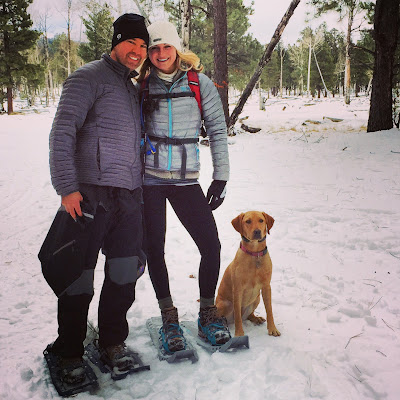
On Tuesday (yesterday), I was scheduled to see my naturopath, Dr. Popiel. He had recently reached out to Craig and I to tell us about a new treatment I might be interested in trying, Prolozone Therapy. See below for a description from the American Academy of Ozonotherapy website:
Prolozone® is a homeopathic/oxygen-ozone injection technique developed and pioneered by Dr. Frank Shallenberger. It is excellent for all forms of musculo-skeletal and joint pain including chronic neck and back pain, rotator cuff injuries, degenerative and arthritic hips and knees, degenerated discs, and shoulder and elbow pain. Because in many cases Prolozone actually corrects the pathology of the disorder, there is a 75% chance for the chronic pain sufferer to becoming permanently pain free.
Prolozone is a form of non-surgical ligament reconstruction and is a permanent treatment for chronic pain. Prolozone is a connective tissue injection therapy of collagen producing substances and ozone gas which can reconstruct damaged or weakened connective tissue in and around joints. These substances are injected into the damaged connective tissue in and around a joint to rebuild the damaged areas.
By repairing the connective tissue this is all that is needed to permanently reverse chronic pain.
Prolozone Therapy is an injection technique similar to Prolotherapy that uses ozone. The use of ozone causes the joint to heal much more quickly than in traditional Prolotherapy. This is because ozone is a highly reactive molecule and when injected into a joint capsule it is able to stimulate the fibroblastic joint repairing abilities.
Prolozone is derived from the word ozone and the Latin word “proli” which means to regenerate or re-build. It literally means re-building tissues with ozone. It is important to understand what the word Prolozone actually means. “Prolo” is short for proliferation, because the treatment causes the proliferation (growth, formation) of new ligament tissue in areas where it has become weak.
Ligaments are the structural “rubber bands” that hold bones to bones in joints – acting like the body’s shock absorbers. Ligaments can become weak or injured and may not heal back to their original strength or endurance. Ligaments will also not tighten on their own to their original length once injured. This is largely because the blood supply to ligaments is limited, and therefore healing is slow and not always complete. To further complicate this, ligaments also have many nerve endings, and therefore the person will feel pain at the areas where the ligaments are damaged or loose.
We can think of our joints as the hinge on a door. Until the hinge is fixed the door just isn’t going to open or close right and it’s the same exact story with our joints. If we are athletic or if we are just getting older there is some gradual and natural degeneration of the moving parts of the body due to ongoing recurrent mechanical stress, and failure of tissues to repair. This can come from lack of nutrients, lack of circulation, aging and inflammation. When this happens the ligaments, tendons, and cartilage become dehydrated and weaker. This results in laxity and more abnormal mechanical stress and shearing forces on the joint. Abnormal shearing forces and torsion cause more joint dysfunction. This leads to a progressive separation of the ligaments from the superficial covering on the bone called the periosteum. This pulling on the periosteum creates a space, which the body fills in with new bone. These new parts of bone are called osteophytes. They are the premier signs of degenerative arthritis in & around the joint. Osteophytes and joint laxity result in a reduced range of motion, which causes strain on surrounding muscles which then become either over or under worked leading to more dysfunction & pain.
Prolozone causes repair and tightening of the lax structures, partially torn connective tissue and ligaments. Prolozone halts the pain/inflammation cycle. This allows for better circulation, increased blood flow carrying nutrition, and hydration of the damaged tissues. This allows for a healing environment within the joint to develop and results in increased range of motion and decreased pain.
Keeping with our "attack it all and trust that pain reduction follows" approach, this seemed like it was worth a shot, especially given the overwhelming evidence that even in correct alignment, my soft-tissue seems to be a driver (or at the very least, strong contributor) to my headache. So yesterday, we went in for my first Prolozone injections. Since there's always a risk of flare up with injections, and because I had experienced such a bad flare up with my lidocaine injections just a few weeks before, Dr. Popiel agreed it was best to be a bit conservative with volume. He injected just a few spots (six, I think) along my C-spine, my left levator scap, and my right and left trapezius.

The injections themselves felt a bit different than regular injections. As the ozone gas went in, I felt a tightening/pressure and a few hours later, was even able to press down on the injected areas and hear a "crinkling" of the gas. Not painful, just weird! And we felt a pretty good spasm in my left scap when the needle went in....more confirmation of the connection to my head.
Within just a few minutes, I for sure felt a sense of relief from the treatment. I was already having a "good" day so the extra bump in pain reduction was all kinds of amazing. I took it easy the rest of the afternoon, though my pain creeped up a little by last night. Still way better than normal though, so I'll take it.
We had also decided yesterday that I would come back today to try an IV ozone therapy. The goal of trying IV is just to deliver a more systemic dose. We don't know what will be more effective, so why not try both? So this afternoon, Dr. Popiel drew some blood, infused the ozone into blood, and then added it back into my body. It's only been a few hours, so it's hard to tell how different I feel...but we'll see over the next few days and as long as I'm not feeling worse, I'll plan to go back for more IV therapy next week.

So for now, I'm taking it one day at a time...plugging away with my rehab and treatments, enjoying every moment I have with lower pain, and staying positive that there are pain-free days in my near future.
Over the last few weeks, I've stayed pretty busy with my rehab, continuing my weekly physical therapy visits with Dan to strengthen my deep neck flexors while maintaining my new alignment. We've incorporated some other things into my treatment, including exercises to strengthen my external shoulder rotators. We've figured out that the soft-tissue dysfunction and chronic tightness on the left side of my upper back (which goes all the way back to my original bike accident, and therefore has always felt - at least to me - connected to my headache) is coming from my 5th rib. At this point, it's so hard to know what's driving a problem and what's a symptom, but the current approach is simply to attack it all and trust that pain reduction will follow.
Along with my PT, I've had a few more sessions with Anna at Movement Rev as well as acupuncture treatments with Sara Asadoorian-Vagianos at Advantage Sports Acupuncture. My visits with Anna have been focused on opening up my lateral line and superficial front line to aid in my thoracic spine mobility and improved diaphragm function, and improved deep frontal line function. The goal of this is improve the mobility of my spine and hopefully take some of the pressure off my neck.
Even though I've had a lot of dry needling in recent months, it had been a while (i.e. pre- corrected C1/C2 alignment) since I'd had traditional Chinese medicine acupuncture. These treatments with Sara have focused on releasing heat and stagnation in my body, and to restore energy flow, blood circulation, and function along the Urinary Bladder meridian (which runs from the corner of your eye, up and around your head, down along the paraspinals, down the sacrum & hamstrings, and ends at the corner of your pinky toe). Sara told me that releasing any blockages or adhesions along the UB meridian will open up the spine on both the functional and energetic level.
Up until about a week ago, I wasn't feeling any changes but then something started to subtly shift and my pain levels were in the "low normal" to "below normal" (as anyone who deals with 24/7 pain can relate, a 1-10 pain scale becomes impossible to use). This past weekend, I even felt good enough for a day trip to snowshoe in Flagstaff. Charlie's first romp in the cold, wet, white sand. Pure amazingness.

On Tuesday (yesterday), I was scheduled to see my naturopath, Dr. Popiel. He had recently reached out to Craig and I to tell us about a new treatment I might be interested in trying, Prolozone Therapy. See below for a description from the American Academy of Ozonotherapy website:
Prolozone® is a homeopathic/oxygen-ozone injection technique developed and pioneered by Dr. Frank Shallenberger. It is excellent for all forms of musculo-skeletal and joint pain including chronic neck and back pain, rotator cuff injuries, degenerative and arthritic hips and knees, degenerated discs, and shoulder and elbow pain. Because in many cases Prolozone actually corrects the pathology of the disorder, there is a 75% chance for the chronic pain sufferer to becoming permanently pain free.
Prolozone is a form of non-surgical ligament reconstruction and is a permanent treatment for chronic pain. Prolozone is a connective tissue injection therapy of collagen producing substances and ozone gas which can reconstruct damaged or weakened connective tissue in and around joints. These substances are injected into the damaged connective tissue in and around a joint to rebuild the damaged areas.
By repairing the connective tissue this is all that is needed to permanently reverse chronic pain.
Prolozone Therapy is an injection technique similar to Prolotherapy that uses ozone. The use of ozone causes the joint to heal much more quickly than in traditional Prolotherapy. This is because ozone is a highly reactive molecule and when injected into a joint capsule it is able to stimulate the fibroblastic joint repairing abilities.
Prolozone is derived from the word ozone and the Latin word “proli” which means to regenerate or re-build. It literally means re-building tissues with ozone. It is important to understand what the word Prolozone actually means. “Prolo” is short for proliferation, because the treatment causes the proliferation (growth, formation) of new ligament tissue in areas where it has become weak.
Ligaments are the structural “rubber bands” that hold bones to bones in joints – acting like the body’s shock absorbers. Ligaments can become weak or injured and may not heal back to their original strength or endurance. Ligaments will also not tighten on their own to their original length once injured. This is largely because the blood supply to ligaments is limited, and therefore healing is slow and not always complete. To further complicate this, ligaments also have many nerve endings, and therefore the person will feel pain at the areas where the ligaments are damaged or loose.
We can think of our joints as the hinge on a door. Until the hinge is fixed the door just isn’t going to open or close right and it’s the same exact story with our joints. If we are athletic or if we are just getting older there is some gradual and natural degeneration of the moving parts of the body due to ongoing recurrent mechanical stress, and failure of tissues to repair. This can come from lack of nutrients, lack of circulation, aging and inflammation. When this happens the ligaments, tendons, and cartilage become dehydrated and weaker. This results in laxity and more abnormal mechanical stress and shearing forces on the joint. Abnormal shearing forces and torsion cause more joint dysfunction. This leads to a progressive separation of the ligaments from the superficial covering on the bone called the periosteum. This pulling on the periosteum creates a space, which the body fills in with new bone. These new parts of bone are called osteophytes. They are the premier signs of degenerative arthritis in & around the joint. Osteophytes and joint laxity result in a reduced range of motion, which causes strain on surrounding muscles which then become either over or under worked leading to more dysfunction & pain.
Prolozone causes repair and tightening of the lax structures, partially torn connective tissue and ligaments. Prolozone halts the pain/inflammation cycle. This allows for better circulation, increased blood flow carrying nutrition, and hydration of the damaged tissues. This allows for a healing environment within the joint to develop and results in increased range of motion and decreased pain.
Keeping with our "attack it all and trust that pain reduction follows" approach, this seemed like it was worth a shot, especially given the overwhelming evidence that even in correct alignment, my soft-tissue seems to be a driver (or at the very least, strong contributor) to my headache. So yesterday, we went in for my first Prolozone injections. Since there's always a risk of flare up with injections, and because I had experienced such a bad flare up with my lidocaine injections just a few weeks before, Dr. Popiel agreed it was best to be a bit conservative with volume. He injected just a few spots (six, I think) along my C-spine, my left levator scap, and my right and left trapezius.

The injections themselves felt a bit different than regular injections. As the ozone gas went in, I felt a tightening/pressure and a few hours later, was even able to press down on the injected areas and hear a "crinkling" of the gas. Not painful, just weird! And we felt a pretty good spasm in my left scap when the needle went in....more confirmation of the connection to my head.
Within just a few minutes, I for sure felt a sense of relief from the treatment. I was already having a "good" day so the extra bump in pain reduction was all kinds of amazing. I took it easy the rest of the afternoon, though my pain creeped up a little by last night. Still way better than normal though, so I'll take it.
We had also decided yesterday that I would come back today to try an IV ozone therapy. The goal of trying IV is just to deliver a more systemic dose. We don't know what will be more effective, so why not try both? So this afternoon, Dr. Popiel drew some blood, infused the ozone into blood, and then added it back into my body. It's only been a few hours, so it's hard to tell how different I feel...but we'll see over the next few days and as long as I'm not feeling worse, I'll plan to go back for more IV therapy next week.

So for now, I'm taking it one day at a time...plugging away with my rehab and treatments, enjoying every moment I have with lower pain, and staying positive that there are pain-free days in my near future.
Thursday, February 12, 2015
the last few weeks
Headache wise, the last few weeks have been a bit of a roller coaster for me. As of last week, I hadn't experienced any changes in my headache since my trip to Austin. My jaw popping had definitely improved, thanks to the splint I've been wearing 24/7...and that's definitely a positive, but still disappointing that any improvements made weren't reflected in my pain levels.
Last Wednesday, I had a follow up with my neurologist, Dr. Dodick. As you can probably imagine, these visits have become less like doctors appointments and more like strategy meetings between him, Craig, and myself. We had sort of come up with this working hypothesis - that if the source of my pain was a misaligned C1/C2, which was causing soft-tissue dysfunction through my neck and upper back, which in turn was feeding the pain-spasm-pain cycle and we had corrected the misaligned vertebras but the pain remain unchanged, we needed to attack the soft-tissue in some other way. Craig describes it as a "time sequence puzzle". I could have strengthened the hell out of the muscle before or worked to improve the quality of the soft-tissue (which I tried to do) but if the misalignment wouldn't let it hold, how could I have possibly gained any traction?
I had already tried some intensive massage a few times per week since returning from TX without progress. But Craig and I were hopeful as we remembered back to my first Botox experience 2 years ago. My only "response" to Botox in spring 2013 was a significant reduction in head pain the following day, which Dr. Dodick told us couldn't have been the actual Botox because it takes a minimum of several days to start working, usually peaking around the 1-2 week mark. Instead, we collectively assumed it was just the actual needles releasing tension in my muscles (the Botox injections were ALL over my head/face/neck/shoulders).
So last week, Dr. Dodick, Craig, and I decided that we'd attempt to recreate that same effect by starting a series of injections over the next few months that would alternate between lidocaine (a local anesthetic) and Botox. In the meantime, I'd also try out a muscle relaxant, Soma, to see if that would help nudge my muscles in the right direction. I started Soma on Wednesday night and then switched over to another version of it that also contains Codeine (an opioiod pain medicine).
Then on Friday afternoon, I was scheduled to see a new physical therapist, Dan Daliman. Mark, my PT in Austin, had found Dan for me to follow up with and re-check my alignment. Based on what Craig was feeling with his hands, we thought it was okay, but given that my pain hadn't budged, we were both looking forward to having another person take a look. According to Dan, my C2 was out just a little bit, so he used some muscle energy techniques to realign it. He also started me on some basic strengthening exercises of my deep neck flexors...his logic being that these stabilizing muscles (like the longus capitus and longus colli) are weak, and consequently, my larger, more superficial neck muscles (like my sternocleidomastoid (SCM) and scalenes) take over.


So naturally, after a few sets of chin tucks and the like (see below), I had a complete meltdown. Not because this didn't make sense to me (because it does!) but because this is a treatment approach we've tried so many times before and when I start hearing the same explanations and am prescribed the same rehab exercises all over again, this feeling of sheer panic starts to set in and the voice inside my head says, "holy shit....no one can help me." But Craig reminded me over and over that because of the new position of my spine, things I've tried before were different now. I knew he was right but keeping a positive mindset is always easier said than done. But since my sanity and quality of life pretty much depend on it, I don't let feeling discouraged get in the way of committing 100% to the path of treatment I'm pursuing, so I headed in to the weekend ready to tuck the shit of my chin (for reps of 12) all. day. long.
I was also having a hard time on Saturday because my birthday was the next day. The big 2-7. No, I'm NOT one of those people who bitches about turning a year older...because my boyfriend is 14 years older than me so I will be...forever young. Kidding! A fear of aging is actually a pet peeve of mine, and one I'm committed to keeping for the rest of my life. Just being able to turn a year older is a privilege taken from too many people too young. Out of respect for those whose time is cut short, how can we complain? This is eventually the realization that snapped me out of feeling sorry for myself. (But for just a little while, I did feel sorry for myself). I was bummed out that I was turning a year older and my headache hadn't changed one bit since my 26th birthday. Last February I was in the neck brace as part of the treatment I was doing with Dr. Crutchfield in Baltimore, so Craig and I went for a hike and I promised myself that by next February 8th, not only would I be on a birthday mountain ride, I'd be half way through the 2015 MBAA race series.
But then something kind of strange and equally amazing happened. Over the course of the afternoon, my headache gradually dropped a few notches. Still there, still painful, but noticeably different than "normal". On Saturday night, we went to see one of my favorite bands play, The Avett Brothers, and unlike almost every concert we've been to in the last year or so, I was able to stay for the entire show!
And it gets better. I woke up Sunday morning and my pain was still quite a bit less than normal. Talk about a birthday present! Not sure if this was the best idea, but out of pure celebration and a "f*** it, it's my birthday" attitude, I even joined Craig for a nice easy mountain bike ride. Sunday night came and went. Then Monday. My pain was still low. It was GLORIOUS.
By Tuesday morning, it had started to creep back up again and continued to do so until I was back to my normal headache on Tuesday night. I had been vigilant about my PT exercises, was still taking the muscle relaxant, and had scheduled a session with my friend Anna at Movement Rev to work on my thoracic spine mobility.
On Tuesday afternoon, Craig and I headed over to Mayo to start my first round of injections with Dr. Dodick. That morning, Craig took to my back and neck with a pen and helped me mark all of the spots for Dr. Dodick to target with the lidocaine. After 15-20 injections, Dr. Dodick told me that if this did affect my pain, he'd expect it to be relatively immediate. I had another PT session on Wednesday morning, adding in a few more strengthening exercises for my deep neck flexors. By Wednesday night, I felt totally wiped out and my pain had started really creeping beyond "normal".
That trend continued into Thursday, so that made for a kind of rough day, but it wasn't until Thursday night that things took a really bad turn. Around dinner time, my headache spiked to a level it's only been at a few times in the last few years (one of those times being my ketamine infusion in the fall). It felt like a rod was going through my temples and that lasted through the night and into this morning. I was couch-bound until about mid-day and it finally started to subside, though I still feel substantially worse than my typical headache.
We're not really sure why the injections into my muscles had that effect, though it is somewhat encouraging because it reinforces our hypothesis that soft-tissue is driving the pain. It's so hard to know for sure, but it's possible that the misalignment was originally causing the soft-tissue tightness and now that the alignment is corrected, the pain could be driving the tightness. Either way, the improvement I felt last weekend and the more recent pain spike affirms that the pain and tightness are intimately related. Now we've just got to figure out how to stop both.
Subscribe to:
Posts (Atom)