I'm 7 weeks (and 2 days) post-op and figured it was time for another update. I guess I had sort of been waiting for a big breakthrough moment in my recovery before a new post, but decided a new year was reason enough. And I have been pretty busy at work trying to become pain-free, so here goes...
Actually - first, to balance out the highly impersonal anatomy diagrams that fill the rest of this post, a late happy holidays and new year from Craig, Charlie and I.
You'll notice I'm sans-neck brace when this photo was taken on our front porch on Christmas day, which just means it was preceded by...me convincing Craig I needed to take it off because despite him telling me that he only thinks happy, healing thoughts when he sees me in a neck brace (have to love him for it), there was no way I was taking a family picture with it on...and proceeded by me strapping the hard collar back on as fast as possible without moving a muscle. Hah!
And here's our Charlie girl posing in front of the tree.
And my 3 most effective forms of medicine on New Year's day: hiking, Craig, and my pup.
Now the pain update: Headache is still here. I've had a few less-than-normal pain days and a few worse-than-normal pain days, but for the most part, a lot of normal pain days. As I explained in my last post, I do really still feel like it's coming from the soft-tissue (versus the area around my C1/C2 instability that I felt prior to surgery). And I'm still choosing to interpret that as a POSITIVE sign.
Just over two weeks ago, Craig and I flew back to Tampa for my 6-week follow-up with Dr. Franck. Man, I am so over flying to Tampa. I had x-rays taken here in Arizona that Saturday so they were ready for Dr. Franck to review by Tuesday morning when we met. Getting the x-rays felt like a big step because my hard collar came off and for the first time since before surgery, I had to move my neck around to get the different views. It wasn't particularly painful, but very stiff.
After looking at the films that Tuesday, Dr. Franck told Craig and I that he was happy with how I'm healing (which is awesome). You can see the placement of the hardware in the pictures below, and also the white kind of blurry area between C1 and C2, which is the matrix of new bone growth from my donor stem cells.
I got the go-ahead from Dr. Franck to transition out of the hard collar and into a soft collar. As uncomfortable as the hard collar was, it really hadn't bothered me a whole lot since waking up in it on November 17th. Maybe it was just the conscious decision from the start that I wasn't going to let it bother me (because how miserable would that be if I had woken up every morning for the last month and a half obsessing over how uncomfortable a brace was?)...or, maybe it was because the brace felt like it was part of the solution and therefore something I couldn't hate...or, or maybe it was because my headache has been bad enough since surgery (and the 3.5 years prior to surgery) that it just hasn't allowed the inconvenience of a neck brace to qualify as discomfort (if that makes sense). Don't get me wrong, though, it did feel damn good to take off, especially because it meant I could finally take a shower without a brace on my neck. I think I may have taken 30 minute showers for the first few days after that. Also, I can drive now!
So back to my pain. My biggest concern at this point wasn't that I still have my headache (recovery is a process, I get that), but just that my recovery (at least pain-wise) seems to be taking longer than most people who have had this procedure. In the literature Dr. Franck's published, headache intensity was reduced on average by 96% at the 6-week postoperative interval.
(This is from The Craniocervical Syndrome and MRI)
When I voiced my concern about this to Dr. Franck, he agreed that I was definitely taking longer than most patients to experience a reduction in my headache, but also said that like Craig and I (and all of the therapists I've seen in the last 1.5 months, he's encouraged about the changes I feel in the SOURCE of my headache. He told me to start a few isometric strength exercises (literally just resisting the push of my hand into my head in 6 different directions) and gave me the green light to start a bit more structured physical therapy (without coming out of the soft collar though). He also instructed me to continue wearing the bone growth stimulator around my neck four hours per day for another 4 months. I'll have new x-rays taken in February before I come out of the soft collar (about 5 weeks from now), which he'll be able to review without us having to travel back to FL (!!!), and then we'll fly back at the 6-month post-op mark (May) for another visit.
SO, that went about as well as it could have. Now the question of how to keep doing everything I can to keep moving in the right direction and hopefully start feeling some substantial relief soon...
I've been seeing a physical therapist, Kara, at EXOS about twice per week for a few weeks now. She's been dry needling my upper traps to try to break up some pretty serious knots, and doing some light massage on my scalp and around my incision to help with the scar tissue. Next week, I'll start a once-weekly appointment schedule with Jeff Beran (the PT I've seen in the past) and will gradually be able to start transitioning to some movement-based rehab. I know my neck is really weak right now, and I know that weakness causes tightness and tightness causes pain, so hopefully I'll be able to start breaking that cycle and address some of the other dysfunction I have going on in my movement mechanics. I'm also looking forward to him using the K-laser on my surgery site. I seemed to have a better day following some laser treatment with him a few weeks back. The laser uses specific wavelengths of light to increase circulation and decrease swelling, inflammation, and scar tissue formation.
And on Tuesday, I saw Veronika Campbell, another PT I've worked with on and off over the last few years, who specializes in manual therapy, neural, and visceral mobilization. She worked on the link between my ophthalmic nerve and greater occipital nerve at the coronal suture where they together. This felt really good because that area of my scalp (shown below where the coronal suture is) is very tender/tight feeling. I can't find a great diagram to show both of these, but the red line on this image indicates where they come together at the suture line.
She also worked on the attachments of my falx cerebi (a small sickle shaped fold of dura mater that you can see in the diagram below) into my cranium...
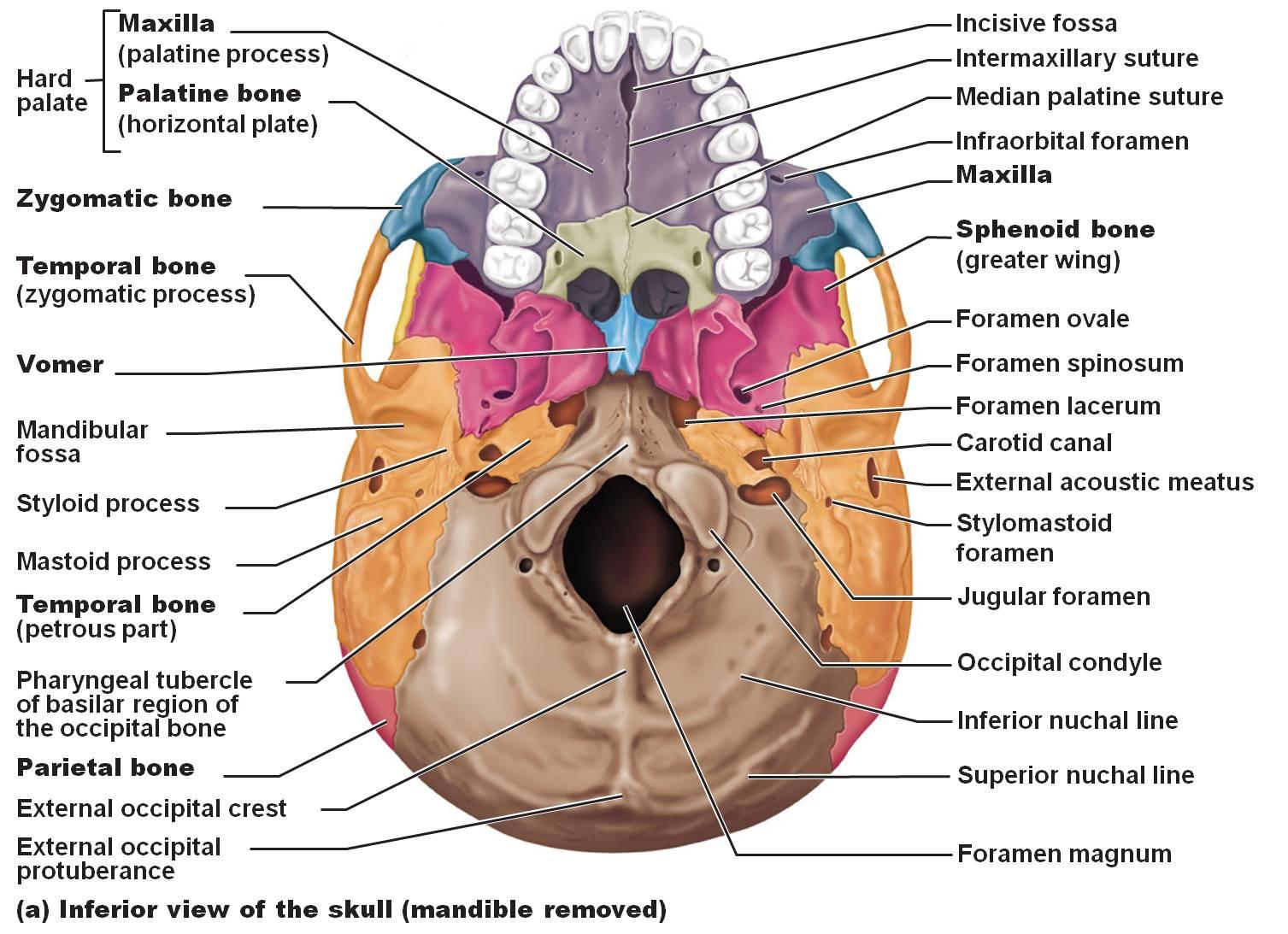
...and the fascia at the insertion near the jugular foramen and the suture (look about half way down the right side.)
Lastly, she did some nerve mobilization to the accessory and dorsal scapular nerves.
Sorry the image overload, but if you're a visual person like me, maybe that's helpful.
I had been having a pretty strong flare up in pain on Monday and Tuesday, and since Tuesday (when I had PT at EXOS in the morning and PT with Veronika at night), that seems to have settled back down. The spike in pain was probably my own fault - I think I had done a little too much workout-wise over the weekend, including a few things I'm probably not ready for yet (like versa climbing and pilates arm work). Live and learn.
So there's the update. Hoping that next week is better than this one and the week after that is better than next.
Someone asked me the other day during my workout if I've gotten used to being in pain. A valid question, but a tricky one to answer. After having a 24/7 headache for somewhere between 1,000 and and 1,300 days in a row (I'm not sure the exact date they transitioned from intermittent to constant), yes, I have gotten used to it. Of course my threshold for pain has increased (how could it not?) But, (and I think about this often), If I didn't have the headache I have now and I just woke up one morning with this headache and knew it would be gone the next day like most headaches are, I would stay home from work. I would skip my workout. I'd ask Craig to take Charlie for a walk and to pick up dinner on his way home. I'd lay down...maybe watch some TV. Basically, it'd be a bummer of a day. When that becomes your everyday reality, though, you have no choice but to get better at dealing with pain...to go on with life with the most positive attitude you can muster. But becoming better at dealing with it doesn't make the pain hurt any less. I hope that makes sense. And THAT is why I'm ready for this thing to be gone for-ev-er.
Almost done. Here's one final picture of what my scars look like today. They're definitely healing well, and as more time goes by, we'll be able to get a little more aggressive scraping them to help break up the scar tissue. For now, it's mostly light massage and pinching the skin around the incisions. My beautiful buzz cut is growing out quite nicely too.
Lastly - Over the last few months, I've had quite a few people send me emails who are on similar headache paths and have come across my blog in their quest for answers. When I started recording my story over two years ago, I never imagined there were so many people out there, in pain, asking the same kinds of questions, seeing the same kinds of doctors, trying the same kinds of treatments, and facing the same roadblocks along the way. I didn't think it was possible to feel more motivated to get rid of my own headache until hearing the stories from strangers who I share this journey with. So to all of the people who have communicated with me after reading this, thank you. It's pretty amazing how impactful the support of strangers can be and I hope my story (which is not over yet) can provide the same kind of inspiration to you as yours have to me.
Thursday, January 7, 2016
Monday, December 7, 2015
3 weeks post-op
Tomorrow, 12/8, I'll be 3 weeks post-op so I figured it's probably time for an update, so here we go. I'm going to take the lazy writing route this morning though and bullet this thing out.
My surgery recovery is going well. I have no surgical pain left - that actually ended just a few days after surgery. I do have a numbness through the left side of my scalp and this weird sensation that can only be described by the feeling that you've slept with your hair up tight and then taken it out (not painful, just weird). But that's not the big question...
Yes, I do still have my headache. At face value, that seems disappointing (obviously complete and immediate resolution of my headache would have been best case scenario), but apparently not totally unexpected or a reason to be discouraged. For starters, there's still a lot of inflammation and swelling going on (though it has improved quite a bit in the least few weeks). When I got my stitches out last Thursday, we could feel a pretty a pretty knotty band of swelling right along my incision. I've been trying to bring that inflammation down with heat packs for now, and once I transition to a soft collar on 12/29, I'll be able to start some other manual therapy like scraping, etc. I've also been having a lot of tightness through my upper traps and shoulders, which I feel pretty confidently is contributing to my head pain. I'm going to be starting some light massage this week (and possibly some needling) to try to get those muscles relaxed. Although I need to be in the hard collar right now to limit mobility and allow the fusion to heal, the collar is also likely contributing to the surrounding tightness. So I guess the greatest challenge over the last few weeks has been more mental than anything else...trying to stay positive and believe that there are headache-free days ahead. I told Craig a few days ago, after someone asked about my progress and I told them that it really shouldn't be discouraging that I'm still in pain because blah blah blah and then they complimented my "positive attitude", that I just don't want my optimism to be the reason for the answer I'm giving...I just want it to be true.
Until we go back to Dr. Franck's for my follow-up on 12/29, the collar stays on 24/7, including sleeping, showering, etc. and I wear a bone stimulator device that sits around my neck for 4 hours per day. This collar is actually a lot more comfortable than the one I was in for 6 weeks earlier this fall while doing the prolotherapy and PRP and it really doesn't bother me at all any more. It just comes off for a few minutes in the morning or evening when Craig (or my mom) changes my bandages. Because all the stitches out out, I don't have to wear a bandage anymore but have found it to be much more comfortable than having my incision touch the brace all day. Craig's taken pictures on most days so we can see the progress in swelling (and of course measure how fast my amazing buzz cut is growing).
Thankfully, I did get the go-ahead to start some "light" exercise. Having not been able to do much of anything but walk over the last few weeks has made me appreciate just how much working out helps me mentally deal with my headache. So it felt pretty damn good to at least break a sweat this morning. With Craig's help, I've started with some real basic bodyweight and air resistance stuff, including a little Pilates work. The biggest priority right now, aside from obviously not moving my neck, is to keep tension out of my traps and shoulders. Instead of a traditional spin-style stationary bike, I'm finding that a Keiser arm bike (similar to an Airdyne) is actually more comfortable because I can maintain a much more upright position.
I'll plan to post an update again once I've started with some manual therapy and hopefully give the swelling a chance to subside. Thanks again for all of the well wishes over these last few weeks!
Thursday, November 19, 2015
cervical fusion & craniectomy update
It's been about 2.5 days since my surgery and I'm finally feeling good enough to open my computer for a quick update. Before I get to that though, a HUGE thank you to everyone who's sent their well wishes my way over the last few weeks and days. Friends, family, Craig's coworkers, everyone near and far...I (we) have been so grateful for everyone's love and support. And a very special thank you to Tino and Angelika at Quality K9 for taking such great care of Charlie while we're gone, and sending us lots of photos of her practicing "snuggle" for when I get home and need it the most :)
Surgery really went as well as it could have gone Tuesday morning. I'm in a fair amount of pain right now, but nothing that shouldn't be expected. A lot of the pain is just from the incisions themselves, but some is from a spike in my headache from all of the inflammation going on from surgery. That sounds a little discouraging, but I've been assured it's nothing to be concerned about. It will probably take a few weeks for everything to settle down.
But I'll back up a few days. Craig and I arrived in Tampa on Sunday night and my mom flew in on Monday morning. Monday was a full day - first I was scheduled for another digital motion x-ray (DMX), then we had to drive across town for another upright MRI, and then had to go back to Dr. Franck's office for my pre-op appointment. I don't have a copy of the DMX video yet (I'll post it here when I get it), but the findings were even worse than my original study showed 2 years ago. The DMX showed 7.5 mm of excursion on my right side and 10 mm on the left. To give you some context, 0-2 mm is considered "normal" and anything over 3.4 mm is considered a surgical candidate. Dr. Franck said that this was probably the worst instability he's ever seen...so severe that there really wasn't any more room for my C1 to move. In side bending, it was sliding all the way over until it hit the dens of my C2.
My upright MRI showed a disrupted transverse ligament and a capsulo synovitis at C2 against my brainstem (made worse with flexion). It also showed a tonsillar ectopia, where the bottom of my cerebellum was crowding my brain steam and basically jammed up against my skull, restricting the flow of my cerebral spinal fluid. I'll come back and add some of these images when I get a copy. So by the time Monday night rolled around, we were obviously feeling even more confident that the C1/C2 fusion (to correct the instability) and the craniectomy (to stop the crowding of my cerebellar tonsils and brain stem) was the right thing to do.
Tuesday morning, we arrived at the surgical center at 6am, and I was in surgery by about 7:30. We were told the procedure typically takes about 4 hours (a big chunk of that time used for the placement of my body (face down and held in place by placing screws into the side of my head - one on one side and two on the other) and the alignment of the intra-operative CT scanner radar system (ie. Stealth). But, the surgery went so well that it only ended up taking them about 2.5-3 hours total. As is pretty much always the case when having surgery, I knew that the healthier I went into it, the easier every part of my recovery would be. That definitely motivated me to keep working out as best I could until this past weekend. In fact, I set a few PRs in the gym over the last few weeks - a seemingly insignificant victory, but every mental win going into this surgery has helped me maintain a positive mindset.
So here I am before heading into the OR.
To give a recap on the actual procedure, Dr. Franck and his team made a small incision at the top of my cervical spine, below my skull, and then two small insertion points at the base of my cervical spine. Two 4 mm diameter titanium screws were guided from the insertion points to connect C1 and C2. Then, two square cm of bone from my occipital skull base were removed. In addition to the screws, they also added bone matrix material (with stem cells from a donor), directly on C1 and C2 to help create a bony fusion. Waking up from surgery is still pretty hazy, since I was on quite a few different drugs, but after just a few hours in recovery, we left the surgical center to go back to the hotel. They sent a nurse who stayed with us for the next 24 hours in the hotel and monitored me overnight. The surgical pain wasn't actually as bad as I was expecting, though last night and this morning were a bit worse than the first night. Right now, I'm on Oxycontin (for pain), Norco (for pain), and Flexeril (a muscle relaxant), plus taking a few natural anti-inflammatories like high-dose curcumin and tart red cherry juice.
Wednesday morning, we went back to Dr. Franck's office for my bandages to get checked and changed. I woke up from surgery with my neck brace already on and it only comes off for a few minutes after taking a shower so the pads can be changed - which I've only attempted once so far (not so successfully). I also had x-rays taken again to make sure that everything looked the way it should (which it did!)...you can see here the 2 screws and what my incisions look like (and also my sweet new buzz cut).
On Wednesday afternoon, Craig, my mom, and I drove down to the condo we rented in Siesta Key. The plan here is just to relax, relax, and relax some more until December 3rd, when I see Dr. Franck again before flying back home. My pain seems to be fluctuating a bit...going from a high headache and low incision pain to worse incision pain and a lower headache. For now though, I'm just trying to keep the pain under control with the medicine and take each day at a time. I also have to wear an electrical bone growth stimulator for four hours per day, which just sits around my neck and helps the healing process. Tonight we even got out for a short walk on the beautiful white sand beach!
Tuesday, October 20, 2015
ready, set, cervical fusion!
It's been a few weeks now since Craig and I returned from our second visit to Ft. Myers for my regenerative ligament treatment (a combo of prolotherapy and PRP injections). Round two admittedly took a little more mental energy than the first, as has been the case for any treatment protocol I've started and had to stick with despite a lack of headache progress. But I knew I had to give it a fair shot, which we'd already determined would mean at least 2 treatments. So back we went to Florida.
This time, Dr. Hauser decided he'd add some extra facial nerve blocks (with two analgesics: Serapin and Chloroprocaine) to the normal series of injections. I'm not sure what the final count of injections was because I lost track around 50, but either way, a lot. Here's a not-so-great picture post-procedure, but you can at least get an idea for injection sites (each little dot on my back and neck is from an injection + more up my scalp under my hair).
After my appointment, Craig and I headed straight to the airport to fly home. I've found that most of the soreness from the prolotherapy and PRP takes a day or so to kick in, but it definitely wipes me out. And because the solution he injects is working to tighten the ligaments, that's basically the sensation I feel afterwards...almost like I'm wearing a neck brace from the inside.
Speaking of a neck brace, by this point I'd had the hard collar on for about a month. Aside from dealing with the bizarre shit that people (mostly strangers) would say to me, I'd gotten pretty used to wearing it. Granted, I had the green light to workout with it on (as long as I cut out overhead movements from my lifting and didn't get too crazy with the rest), so that was helping deal with the mental stress. But then two weeks came and went. I spoke to Dr. Hauser on the phone and though I think he would have been open to pursuing a third treatment, I really wasn't feeling optimistic that it was worth continuing. And every day that passed without a change just made me more optimistic that the fusion with Dr. Franck was the right thing to do next.
So, that's what I'm doing. In a few weeks, Craig and I will fly to Tampa for the procedure. We'll fly in on a Sunday, I'll have some pre-op stuff to take care of Monday, including an up-to-date digital motion x-ray (DMX) and an upright MRI (since the one I had a few months ago didn't include all of the views that Dr. Franck wants), I'll have surgery on Tuesday, and then we'll need to stay in the area for about 2 weeks while I recover. We rented a beach condo in Siesta Key (because hey, if you gotta recover from surgery, you may as well do it right). Then I'll have a follow-up appointment before we fly home in early December.
I know I detailed the whole thing in my last post, but here it is again for anyone who cares:
To recap, the goal of this procedure is to get rid of my headache by targeting 2 mechanisms of pain:
1. Compression of my spinal cord (caused by the capsular synovitis is pushing into it) could be interfering with the flow of my cerebral spinal fluid.
2. My vertebral artery is compressed as a result of the instability. The vertebral artery provides huge flow to the brain stem, so when that supply is occluded, it causes poor circulation of cerebral spinal fluid.
During surgery, I'll be placed face down on the operating table. Dr. Franck will use an ultra hi-tech radar guidance system, called the STEALTH, in combination with an intra-operative CT scanner, called the O-Arm, to target C1-C2. A small incision will be made at the top of my cervical spine, below my skull, and two small insertion points at the base of my cervical spine. Using the STEALTH radar system, two 4 mm diameter titanium small screws will be carefully guided from the insertion points, by a minimally invasive technique to connect C1 and C2. Bone fusion material will be directly placed on C1 and C2. Finally, two square centimeters of bone from my occipital skull base at the top of the spine will be removed in order to remove the pressure on the base of the brainstem shown on the upright MRI.
How am I feeling about all of this? In one word: fucking-ready. Maybe that's two words, I'm not sure. Either way, I'm just incredibly anxious and excited to get it done and get the recovery rolling. Most people who've asked me about it hear "fusion surgery" and respond with an "oh no!" or "I'm so sorry!" And I get that...because surgery (especially neurosurgery) never seems ideal, but what most people probably don't appreciate is that after spending the last 3.5-4 years of my life in 24/7 pain, I would do absolutely anything to get rid of my headache. ANYTHING. Two years ago, I quit my job to focus on getting better. I've seen well over 100 medical practitioners along the way. Craig and I have traveled all over the country to see top specialists. We've spent more time, energy, and money than I know how to quantify searching for answers. And even though I've been fighting to maintain a positive, forward-thinking mindset as best I can, there have been a lot of really hard days when I've questioned whether I'll ever be able to live without a headache. So I guess what I'm saying is that it matters less to me what the solution is and more that there is one.
Post-op, I'll be in a hard collar again for 6 weeks and then will transition to a soft collar for another 6 weeks. I won't be able to drive during that time, which might be a little challenging, but we'll figure that out. I'm guessing Charlie and I will just walk 20 miles a day or something, hah! From there, I'm still not totally sure what my recovery is going to look like. Dr. Franck did tell us that by the 6 month mark, I should be back to doing pretty much everything I want to be doing, which is pretty awesome.
I'm sure I'll have more to write (and definitely time to write) when we're in FL in a few weeks. Can't come soon enough!
Saturday, September 5, 2015
neurosurgery consult + first round of platelet-rich plasma therapy
Craig and I traveled to Florida this past week for my (long-awaited) visits with neurosurgeon Dr. Franck in Tampa and regenerative medicine specialist Dr. Hauser in Fort Myers. It was an exhausting few days but overall a successful trip.
We flew in Tuesday night and were scheduled to see Dr. Franck on Wednesday afternoon. The appointment got delayed a few hours due to an emergency surgery he was called into, so we didn't end up seeing him until around 5-ish. Dr. Franck had already reviewed my DMX (digital motion x-ray) before we scheduled this appointment and had ordered an upright MRI so we already knew that his initial interpretation of my C1/C2 instability warranted a further conversation, but we were eager to understand the full picture. What exactly did he see in my films? What did he consider to be the mechanism of pain? How does his C1/C2 fusion correct the instability? How many patients have had the C1/C2 fusion? How similar have their cases been to mine? What are the outcomes like and has their relief lasted? What are the risks? What kind of post-op lifelong implications or restrictions would I need to consider?
Fortunately for us, Dr. Franck is an incredibly thorough, committed and compassionate practitioner. Craig and I sat in his office until 9:45 pm hashing out the details of my case. I'll break down the take-aways, but first...
I've included this video in multiple posts already but here it is again for anyone interested in watching. One thing I will say is that if you're reading this because you or someone you know is suffering from chronic cervicogenic headaches (or as is the case with me, one singular 24/7 headache) - whether it's post-trauma like whiplash or not - and you haven't had a digital motion x-ray of your cervical spine, you need to figure out how to get one ASAP- even if your neurologist has never head of it. Then you need to figure out how to find a doctor who knows HOW to read it. I can't tell you how many top neurologists, physical therapists, neurosurgeons, orthopedic surgeons, etc. have watched this video and said "Wow, that's interesting. But I'm not sure what it means because I've never seen one before."
There are 22 major ligamentous structures in the cervical spine and the upper 30% of of the cervical spine gets its stability from ligaments only. Digital Motion X-ray is the only test that will detect sub-failure ligament injuries. MRIs and traditional x-ray's CANNOT detect the stretching or an elongation of a ligament.
Dr. Franck pointed out the rocking of my C1 in the nodding view with my occiput barely moving (it should be the other way around). When I go into flexion, instead of seeing a nice even curve distributed throughout each vertebra, you can see how C5 acts as a fulcrum. In the open mouth view, my atlantoaxial instability is pretty glaring. We originally thought the excursion of these vertebra measured 4 mm on my left and 3 mm on my right, but Dr. Franck showed us (by looking at the lateral atlantodental interval), that it's actually more like 6 mm on the left and 5 mm on the right. You can see the lateral mass of my C1 banging into my odontoid process. What does this mean? Basically that my C1 and C2 are really loose - even worse than we thought.
Next we reviewed my regular MRI. If you've been following along for a while, you might remember me writing about the concern we've had around the "kink" in my spinal cord (see yellow arrow)- an observation that's caught the eye of a few practitioners but has ultimately been written off as insignificant.
But in Dr. Franck's mind, the kink is totally significant. He explained that because my ligaments are damaged at C1/C2, my dens (i.e. the bony process where C1 and C2 articulate) is being pushed backwards. As a result, there's inflammation occurring around the surrounding bursa of synovial fluid. You can see that inflammation where the black space is in the photo below (see pink arrow). It ends up pushing into my spinal cord, causing the kink. Aha!
He's also concerned about this cerebellar tonsillar ectopia, as shown by the blue arrow. This is where the tonsils of my cerebellum are sinking too low. He hypothesizes that this is a result of damage to my denticulate ligaments, whose function is to stabilize the spinal cord within the vertebral canal.
Unfortunately my upright MRI wasn't much help to us because the place I went to get it here in AZ failed to take the correct positional views, so if I move forward with surgery we'll get one done in Tampa first.
The million dollar question is obviously WHAT is causing my headache. We talked through a few possible mechanisms of pain:
1. Compression of my spinal cord (caused by the capsular synovitis is pushing into it) could be interfering with the flow of my cerebral spinal fluid.
2. My vertebral artery is compressed as a result of the instability. The vertebral artery provides huge flow to the brain stem, so when that supply is occluded, it causes poor circulation of cerebral spinal fluid.
Dr. Franck is incredibly confident that his C1/C2 fusion surgery can help me. He's performed it on 95 patients so far who have presented with very similar history and symptoms and 94 of them have had lasting improvement/complete resolution of their pain. That in itself is obviously encouraging, and I felt even better after learning that I could be expected to return to my normal activity as soon as 6 months post-op.
This fusion is a bit different than standard C1/C2 fusions, where the fusion traditionally includes the occiput and c3. Here's an overview of what the procedure would entail:
At surgery, you will be gently anesthetized for general anesthesia and be monitored closely.
You will be carefully placed face down on the operating table. We will use an ultra hi-tech radar guidance system, called the STEALTH, in combination with an intra-operative CT scanner, called the O-Arm, to target C1-C2.
A small incision will be made at the top of the cervical spine, below your skull, and two small insertion points at the base of your cervical spine.
Using the STEALTH radar system, Two 4 mm diameter titanium small screws will be carefully guided from the insertion points, by a minimally invasive technique to connect C1 and C2.
Bone fusion material will be directly placed on C1 and C2. Finally, two square centimeters of bone from the occipital skull base at the top of the spine will be removed if needed, in order to remove the pressure on the base of the brainstem shown on the upright MRI.
The operation will take about four hours start to finish and during surgery I make a point of letting your family know how things are progressing in a timely fashion.
Here's an x-ray showing where the screws would be placed:
Post, op, I'd stay in Tampa for about 2 weeks. I'd wear a hard-collar for 6 weeks and then transition to a soft-collar for another 6 weeks, using a bone stimulator a few hours each day to help with healing.
SO, as we left the parking lot of his office just before 10 pm, grabbed a quick dinner at Chipotle and got back on the road for the 2 hour drive to Fort Myers, we had a lot to think about. Overwhelming...yes, but I think in the best way possible. As awful as the physical pain of my headache is, the biggest stress/frustration/fear I experience on a daily basis is always related to what I don't know: What's causing my headache? Will I ever find a solution? Does a solution even exist? What is the rest of my life going to look like if I have to live with this? Being able to have such a conversation where these questions could actually be addressed in a concrete and straightforward way, rather than throwing arrows at a dart board and hoping for the best, gave both Craig and I more hope than I think either of us have had until this point.
Thursday morning came just a few hours later and off we went to Caring Medical for my visit with Dr. Hauser. As optimistic as we were about the surgery, it still seemed like it made the most sense to give the regenerative treatments that Dr. Hauser had to offer a chance. We knew that he shared the same ideas around my C1/C2 instability and the mechanisms of pain that we'd discussed with Dr. Franck, but that the interventions were obviously less invasive. After going through a consult and exam, Dr. Hauser decided that instead of prolotherapy, platelet-rich plasma therapy (PRP) would be most appropriate. PRP involves extracting blood from the patient's arm, putting the blood into a centrifuge and spinning the blood about 6 minutes to separate the red and white blood cells and the platelet-rich plasma (which is full of growth factors). Then that plasma is injected back into the body to promote tissue healing.
Here's an excerpt from Dr. Hauser's website:
How does Platelet Rich Plasma work?
Platelets play a central role in blood clotting and wound healing. Tissue repair begins with clot formation and platelet degranulation, which release the growth factors necessary for wound repair. Platelet-derived growth factors are biologically active substances that enhance tissue repair mechanisms. After platelets are activated at a wound site, proteins are released that directly and indirectly influence virtually all aspects of the wound healing cascade. Studies have shown a direct correlation between the platelet concentration and the level of secretory proteins, as well as the amount of proliferation involved in the wound healing.
Specifically, PRP enhances the fibroblastic events involved in tissue healing including chemotaxis, proliferation of cells, proteosynthesis, reparation, extracellular matrix deposition, and the remodeling of tissues. Bottom line here is that tissues can heal faster with Platelet Rich Plasma treatment.
Dr. Hauser injected me about 30-40 times (yikes, I know). Unfortunately, my resident camera man was off his game that morning and missed one bloody photo op, but he at least captured the aftermath in the form of many, many empty syringes.
The plan is that we'll go back to Tampa (or Chicago, where his other office is) in about 3 weeks for another round of treatment. We should have a pretty good sense of whether or not it's helping by that point. If it is, a full course of treatment could be upwards of 12 weeks. If it's not, we'll loop back to Dr. Frack and likely move forward with the fusion. While I'm getting these PRP treatments, my c-spine needs to be as immobilized as possible, so I need to wear a hard collar 24/7. That's proving to be not-so-enjoyable, as the stranger at the grocery store was so kind to point out to me yesterday by saying, "wow, looks like you're having a bad day!" (sidetone: never say that to someone), but it's obviously a VERY small price to pay if it leads to the outcome I want: no more headache. Dr. Hauser even gave me the go-ahead to do some exercise with the brace on, as long as my neck isn't moving. And hey, I'll take that!
While I'm not feeling any changes yet in my head, other than a pretty stiff neck from all of the injections, I'm hopeful that things could really start to change in the next few weeks. And if my pain hasn't changed, we feel more confident than ever in the next step. More to come soon!
Thursday, August 6, 2015
ready for September
I'm not posting an update on my Tampa trip (yet), due to some curveballs that got thrown my way these past few weeks and delayed our trip until the beginning of September. Such is life right? So here's all that's gone down in the last month and a half.
Shortly after my last post, Craig and I headed back to AZ Pain Specialists. Our goal in returning to the clinic, where I had seen Dr. McJunkin last year for medial branch nerve blocks at C2-C5 and dorsal root ganglion blocks) was to find out what regenerative treatment options they had in their arsenal. We had initially discussed platelet-rich plasma therapy (PRP) and stem-cell therapy but weren't sure they did that at the C1/C2 level (and it turns out they don't). We discussed a few other potential options to explore like peripheral nerve stimulators, which consists of actually implanting a device under the skin that produces a low voltage current, creating a sensation that blocks the brain's ability to sense the perceived pain. While I'm open to pretty much anything that has a chance at getting rid of my headache, this is one treatment that I just refuse to pursue (for a few reasons). We've discussed the actual research with my neurologist Dr. Dodick and for chronic headaches, the short and long-term outcomes really aren't good. But beyond that, I'm more certain than ever that I have a biomechanical/structural issue at the root of my pain that throwing some electrodes under my skin isn't going to fix. We did leave his office with another round of DRG blocks scheduled for a few weeks out though, as I seemed to have some questionable pain reduction in the following hours after last year's.
By early July, I had finished up my third or fourth prolotherapy session (from C2 and below) without progress. They would have expected at least some reduction in pain by this point, so we decided not to proceed with more sessions.
As I detailed in my last post, Craig and I finalized our trip to Florida for my consultation with neurosurgeon Dr. Franck, but had simultaneously stumbled upon a doctor in Chicago who specializes in regenerative therapies (including those in the upper cervical region). Craig got in contact with Dr. Hauser at Caring Medical , who, after reviewing my case, agreed it was worth flying out to see him. Here's two helpful videos of Dr. Hauser explaining how instability at C1/C2 (which we know I have from my digital motion x-ray) can compress the vertebral artery and cause chronic headaches originating from the suboccipital region. Side note: this is basically the same mechanism of pain that Dr. Franck targets, but obviously with less invasive techniques.
The approach Dr. Hauser uses to heal the ligaments at C1/C2 involves a combination of prolotherapy, stem-cell therapy, and PRP.
Lucky for us, he happens to have two offices - one just outside of Chicago and one in Ft. Meyers, FL, just two hours away from where I'll be seeing Dr. Franck. So we arranged my visits with both doctors during our trip at the end of July, just a few days after returning from our vacation with my family in Massachusetts.
Ahh, yes...about that vacation.
Craig and I flew into Boston on a Friday night. His plan was to be there about a week and I would stay closer to two. Even though I always look forward to annual vacations and holidays, they serve as a harsh reminder of another year passed without relief from my headache. Not to mention that they're supposed to be fun, social, relaxing; an self-inflicted expectation that makes my inevitable need to "leave early" from whenever I am or skip out on plans entirely all because of my intractable headache...that much more difficult to deal with.
I was so frustrated by my pain last summer that I told myself I wouldn't fly home again until my headache was gone. So this past Christmas was the first I ever spent away, but by the time this summer rolled around, I hadn't seen my dad or sister in a year (and only my mom for a few days last fall when she flew out to help take care of me during my ketamine infusion), so how could I keep enforcing a now clearly unsustainable rule? Our vacation was going to be low-key, though, so despite the anxiety I was feeling about my head, Craig and I were both looking forward to some time with my family, a few nights showing him around my college town in upstate NY, a day-trip to the Cape, some time at the beach, and some much-needed R&R.
On our first morning there, Craig, my mom, and I took our dog Zoe out for an easy hike in the woods by my parent's. The plan was to spend the rest of the day at my aunt and uncle's house for a family get-together, so when we got back from our hike mid-morning, I took a shower and got ready to leave. Mid-blow dry, I started feeling a bizarre ache in my left side...at first it felt like mild cramp but worsened by the minute and soon I was curled up on the couch in tears while Craig got directions to the closest hospital. When we arrived 20 minutes later, I was quickly ushered through the ER with apparent text-book symptoms of kidney stones. A CT scan soon confirmed that.
Kidney stones? What the f---?
The doctors gave me some narcotics, which got my flank pain under control and I spent a few hours on IV before being sent home. I was expected to pass the stones in a few days and prescribed more pain meds to stay comfortable until then. Craig and I ended up back in the ER in the middle of the night though, as the pain had gotten out of control again. This time, I was given a narcotic called Dilaudid, which helped my kidney stone pain but little did I know, would become my worst enemy over the next week.
We finally got back home early Sunday morning and tried to catch up on sleep. I was still feeling pretty shitty so spent most of the day in bed or on the couch. By Sunday night, things started to get really ugly for me as my headache started to climb beyond its normal baseline. The feeling of a drill going through my temples kept me up all Sunday night and by Monday morning it had reached an unbearable level. I couldn't eat or drink without throwing up, I couldn't sleep and I could barely talk because of the pain. Between my kidney stone discomfort, which wasn't exactly manageable at this point either, and the terrifying headache spike, we were back in the car to the hospital. This time we knew we needed to go straight to Mass General in Boston.
After a long few hours waiting in ER, I was given more pain meds and and later admitted overnight for observation. We had figured out at this point that I was having a rebound headache (layered on top of my normal headache) from the Dilaudid I had been given over the weekend. As uncomfortable as the whole kidney stone ordeal was at the point, I knew it was temporary...the pain I was feeling had an expiration date. My head, on the other hand, was a different story. I knew the increase in pain from the narcotic couldn't last forever, but I was also fully aware that I was in the best hospital in the country with a headache like I had never felt in my life and that I would be leaving the hospital in how ever many days with my headache. It made the whole situation feel more overwhelming than I can explain. Each time a doctor or nurse would ask, "what normally helps your headache at home?", I felt so helpless having to answer, "nothing, nothing helps it". By that point, Craig had been in communication with my Mayo neurologist, Dr. Dodick, who was then able to speak to the doctors at MGH and make some recommendations for my head. Finally, an IV drug called dihydroergotamine mesylate (DHE) seemed to get things under control. Speaking of Craig, if I had any ounce of doubt before this trip that he wasn't the best, most caring, loving, resilient human on the planet (which, for the record, I didn't), it's gone.
By Tuesday, I hadn't eaten and barely been able to drink since Saturday and that was definitely catching up with me too. I was on so many meds at that point that I'm not even sure what was making me sick but any sip of water that went in came straight back up along with plenty of dry heaving. Nice, huh? At some point on Tuesday morning, I woke up with a 103 fever, which was an obvious red flag for a blood infection. Apparently kidney stones can disrupt the whole filtration system enough that bacterial infections can occur. Later that afternoon, off I went to the OR to have a ureteral stent put in (which goes from kidney to bladder). This would stay in for a few weeks until I was finished my antibiotics and then I'd get both the stent and the stones taken out back home in AZ at Mayo Clinic.
I spent a few more rough nights in the hospital and finally got home Thursday night. I spent the next few days in recovery mode - slowly getting my appetite and energy back. My neck and upper back were in rough shape from from being in a hospital bed all week so I had a few massages scheduled, but my head took another turn for the worst on Monday after my first massage. We think I maybe still had some Dilaudid in my system or something. I realized when I arrived back in Phoenix on Tuesday that I had lost at least 10 lbs in 6 or 7 days, which had me feeling really drained.
In the whirlwind of the previous week and half, we hadn't really had time to deal with the obvious question of why the hell I had gotten kidney stones. They don't run in my family, I hydrate like a f-ing champ, I don't drink soda, I don't consume a ton of animal protein, I eat a completely unprocessed diet. The only thing that seems like a potential risk factor is that I consume a fair amount of high-oxalate foods like beets, spinach, and nuts, but could that really be the cause? I still don't know for sure what the reason is but during my consultation with the Mayo urologist the day after I got home, I found out that an anti-seizure medication I was on last summer for my headache, Topomax, is known to cause kidney stones. And even though this was a year ago, apparently the stones can take that long to develop. Awesome.
As I sat in the urologist's office that day, frustration with my headache was boiling over in the same way it had back in Boston when the doctors calmly asked what I take at home for pain relief. My eyes welled up with tears as the doctor walked me through the details of the incredibly routine procedure he'd be performing the following week...but not because I was afraid of getting a kidney stent taken out...What was really making me upset was how f-ing straightforward the whole thing was. I got kidney stones...they hurt, it sucked, I went to the hospital, I had a procedure, I took medicine, and in a few weeks it would all be behind me. That's how these things are supposed to work. So why, three and half years and over a hundred doctors later, do I still have a headache? No temporary pain, however bad it is, compares to the inescapable agony of chronic pain.
On Tuesday (two days ago), I went back to Mayo to get both the stones and the stent removed. Before surgery, they said there was a high probability that my ureter would be inflamed from the stones and another temporary stent would have to be implanted to keep it from closing up, but fortunately, when I woke up, I found out I was in the clear. In fact, the stones didn't seem to be there anymore (maybe broken down on their own) but whatever material they did recover will be tested to know for sure if the Topomax played a role.
Long story short, all of this nonsense is the reason the Tampa trip is pushed to next month (and also the reason I postponed the DRG blocks to a later date). I wanted to have a few weeks for my body to get back on track - to eat well, work out as much as I can tolerate - before beginning the regenerative therapy treatments. I'll be going into a neck brace for the 12 weeks of those treatments so mentally as much as physically, I needed a few weeks to decompress and get my shit together. And before FL, we also have a quick trip back to Austin for a follow up with dentist Dr. Ueckert and upper cervical PT Mark Strickland. I've been wearing my dental splint since we initially saw them back in January and need to figure out the next steps with that.
So...come on September, I'm ready for ya.
Thursday, June 25, 2015
Prolotherapy and Tampa-bound
It's been a rough month or so for me on the headache front. It started with some weather changes that I mentioned in my last post. Those abnormally stormy/humid conditions lasted a few weeks, and reaffirmed the connection between lower barometric pressure and significant spikes in my pain. We're not totally sure the reason for that, but speculate it has something to do with my cerebral spinal fluid flow or inflammation in my cervicogenic region. The weather cleared up and has returned to the glorious dry triple digits that is summer in Arizona, but I haven't seemed to be able to catch a break, headache-wise.
I've been able to continue pushing myself in the gym and getting on my mountain bike when the weather allows for it. Starting my day with a lift feels really good. I know I'm getting stronger with each workout, but most importantly, I feel the stress of my headache melt away. It makes me more mentally resilient...better equipped to handle the next 24 hours of my headache without completely losing it. I wouldn't wish that form of motivation on anyone, but I can tell you that it's pretty f-ing effective.
Needless to say, it's been refreshing to channel my blogging energy elsewhere (Hah! I guess you know a headache is bad when afternoons spent researching the ingredients in laundry detergent and sunscreen are a welcomed distraction...am I right?)
So I had mentioned in my last post that I was beginning a series of acupuncture treatments with Dr. Jing Liu. As hopeful as I was, this round was a bust like all the rest. I knew that if I was going to go down the Chinese Medicine route again, It was going to require some time and patience, so I committed to at least a few weeks of treatment regardless of whether I felt any changes. I completed 10 sessions over the last month(along with drinking my twice daily dry-heave-inducing herbs) but decided to call it quits after Tuesday's session. The whole blood stagnation thing in my c-spine and scalp makes a lot of sense to me, but ultimately, my frustration boils down to feeling like there's still a biomechanical or structural dysfunction in my c-spine. And if something in my neck isn't in the right place, whether it's a result of ligament damage or something else, how can more acupuncture correct it? I'm glad I gave it another shot, for sure, but another series of failed attempts takes a toll on my optimism. Clearly, in need of some new direction.
And...cue the serendipitous turn of events.
The fellow-headache-sufferer from Canada that I mentioned before, who stumbled upon my blog and went to see the atlas-orthogonal chiropractor in New York I had written about, happened to email me a few weeks ago with a link to a video he had found and thought I may be interested in.
The video, which I've posted below, shows neurosurgeon Joel Franck, MD, speaking at the FONAR's Cranio-Cervical Syndrome Symposium in 2013. His presentation is titled, "When the Atlas Shrugs: Post-traumatic Migraine Headaches and Lateral C1-C2 Instability - a New Syndrome; Dynamic Motion x-ray (DMX), pMRI Diagnosis, and Treatment with C1-C2 Transarticular Fusion Utilizing Stealth Image Guidance and O-am Intra-operative Virtual CT Scanning. Yikes, that was a mouthful.
In patients with chronic, post-whiplash migraines/headaches, Dr. Franck is using both digital motion video fluoroscopy and upright MRI and finding in most patients, clear abnormality of the alar or transverse ligaments. The ligament damage is what accounts for lateral slippage of C1 on C2.
Here's a clear explanation of what happens (excerpts taken from Dr. Franck's website):
"...in a whiplash injury, these ligaments may get damaged – sometimes severely so. This is particularly true as regards the Alar ligaments and Transverse ligaments, connecting C2 (the axis), C1 (the Atlas), and the Occiput (Bottom of the skull). As explained before, the Cervical DMX and the Upright MRI demonstrate that in whiplash damage to these ligaments causes abnormal lateral, side to side, sliding of C1 on C2.
This lateral sliding causes abnormal tension on the vertebral arteries. We have demonstrated this in the operating room by directly observing that vertebral artery flow is disrupted by the laxity and abnormal loose movements of C2 and C1.
Abnormal tension on the vertebral arteries causes a wave of spreading contraction in these vessels and this may be the origin of the severe intractable headaches. These post-whiplash disabling headaches are most often described as pounding and throbbing, characterizing them as “common migraine” headaches. This subjective feeling reflects the vascular nature of the headache – waves of vascular contraction and dilatation.
...There is more: Recall that many whiplash patients who sustain Alar and Transverse ligament damage develop inflammation at C1-C2 in the spinal canal. A mass develops in that area which we describe as C1 Capsulosynovitis. Further, many of these patients also develop a sinking of the posterior part of the brain, including the cerebellum, into the opening of the skull base – the foramen magnum, which is called Cerebellar Tonsillar Ectopia.
Together, these two phenomenon cause severe crowding and pressure on the brainstem and vertebral arteries...
...Cerebrospinal fluid (CSF) is produced in the center of the brain in a space called the ventricles. CSF is an “ultra-filtrate” of blood, and is essentially similar to ocean salt water. It also contains immune related proteins and other factors. The CSF circulates around the brain and spinal cord after leaving the ventricles and then is reabsorbed on the top of the brain.
After a whiplash injury that abnormally affects the upper cervical spine, as mentioned, the opening of the base of the skull, the foramen magnum gets compressed or crowded. This can be demonstrated to adversely affect the flow of CSF around the brainstem and spinal cord. This may play a role in the development of the Cranial Cervical Syndrome."
Dr. Franck is treating this condition with a minimally invasive cervical fusion of C1 and C2. Basically he makes an incision at the top of the cervical spine, below the skull, and two small insertion points at the base of the cervical spine. Then, using the STEALTH radar system, he carefully guides two 4 mm diameter titanium small screws from the insertion points, by a minimally invasive technique to connect C1 and C2. Then he applies bone fusion material directly on C1 and C2 and finishes by removing two square centimeters of bone from the occipital skull base at the top of the spine, in order to remove the pressure on the base of the brainstem shown on the upright MRI.
You can see where the screws are positioned here:
Craig and I watched the video with wide eyes and when it finished, kind of looked at each other like, holy shit, this is me. Imaging from the case study he walks through in the presentation mirrors mine to a T - including the C1/C2 "rocking" from my digital motion x-ray and the spinal cord "kink" that shows up in my MRI...sort of resembling a basilar invagination/Chiari malformation but not enough to qualify as remarkable to most doctors who have seen it.
We immediately got in touch with Dr. Franck, who's based in Tampa. After reviewing my motion x-ray and MRI, we got an email from his office "this is a GREAT case - call them and please get her down here ASAP - I can change this gal’s Life." He told us that he's performed the operation for "precisely the indications Katie presents with on over 85 patients worldwide, with remarkable and positive results. While all surgery has risks, statistically, this operation is extremely safe and has a terrific track record of minimizing post-whiplash intractable migraine headaches."
When I saw the email, my eyes immediately welled up with tears, for 2 very different reasons:
1. Indescribable hope and happiness at the prospect of a solution existing that could actually correct the root cause of my headache and mean I wouldn't be in pain the rest of my life
2. Overwhelming fear and anxiety at the prospect of having a cervical fusion - not around the operation itself but all of the questions I already had about long-term outcomes. Would the pain relief last? What if it came back? Would I be able to have an active lifestyle? Could I ever mountain bike again? (The mind moves fast, you guys know)
But like always, Craig talked some sense into me and reminded me that we'd just have to take it one step at a time, starting with a consultation with Dr. Franck. He ordered an upright MRI (which I had done yesterday), and we're scheduled to fly to Tampa in just a few short weeks for the visit.
At some point while all of this was going on, Craig and I decided now was a good time to explore some regenerative therapy. If the ligament instability is truly the culprit, we figured it's worth trying some less-invasive ways of correcting it. So last week, I saw Dr. Cronin at Naturopathic Physician's Group for my first prolotherapy treatment. I know I've talked about prolo before but here's the gist:
Prolotherapy (aka Regenerative Ligament Therapy) is a series of injections used to treat pain from ligament damage. You've probably heard before (or maybe know because of your own injury) that ligaments, joint capsules, and cartilage aren't the best at healing. That's because they have a very slow metabolism and are made of dense, white collagen with a poor supply of fresh blood and nutrients (not to mention the constant structural stress they're under). So prolotherapy works by feeding the ligaments to make them stronger. The nutrient solution that's injected is a combination of glucose and procaine. The ligaments become strengthened as a result of the injections by rebuilding of collagen.
I had my first prolo session last week, my second one this morning, and will plan to go back in two weeks for number three. Dr. Cronin is injecting a few spots from C2 down. He can't hit C1 because that requires ultrasound guidance (prime real estate) and only a few people in the country do that. We figure we'll start with C2/C3 and if we need to travel somewhere to have C1 done under guidance, we'll cross that bridge if and/or when we get to it. So far, I'm not feeling anything positive from the injections (just an increase in pain in the few days after) but that's not abnormal. We're going to give it at least 5 sessions regardless.
In the meantime, I've been adding this collagen supplement to my morning smoothie to help the healing process along. Stay tuned to ALO's blog for an upcoming homemade (delicious) chocolate hemp milk recipe using the same joint-healthy collagen.
I'll plan to post again after my next few Prolotherapy treatments, and definitely after our trip to Tampa. Crazy that in a few short weeks, it'll be the four year mark since my bike accident. Hoping this summer is a game-changer.
Subscribe to:
Posts (Atom)


